
Let’s be honest. Nobody wakes up and thinks, “I want a root canal today.”
You probably landed on this page because your tooth has been killing you for days, maybe weeks. You’ve tried painkillers. You’ve avoided chewing on one side. You’ve ignored it, hoping it’ll go away on its own. And now, at some point maybe 11 at night, maybe early morning you typed “root canal treatment in Bengali Square Indore” and here you are.
First, breathe. You’re not alone in this, and honestly, the fear of root canal treatment is almost always worse than the treatment itself.
If you’re in Bengali Square or nearby areas like Vijay Nagar, Ashish Nagar, Scheme 54, or Palasia there’s a clinic close to you that people genuinely trust. Sommyta Dental House, located at 29A Ashish Nagar Road, Indore, has been helping patients from Bengali Square and surrounding areas get through root canal treatment without panic, without confusion, and without going broke. With over 10 years of experience and a 4.8-star Google rating, they’ve earned that trust one patient at a time.
This blog is going to walk you through everything about what root canal treatment actually is, what the process looks like, how much it costs in Indore, what real patients say, and answers to every question you’re probably too embarrassed to ask your dentist directly.
Let’s get into it.
What Is Root Canal Treatment and Why Does It Sound So Scary?
Root canal treatment also called RCT or endodontic treatment has somehow become the most feared dental procedure in the world. But here’s the truth: the fear is outdated. It belongs to a time before modern anaesthesia, before rotary instruments, before digital X-rays.
Today, a root canal done by a good dentist feels like getting a filling. Most patients are genuinely surprised by how manageable it is.
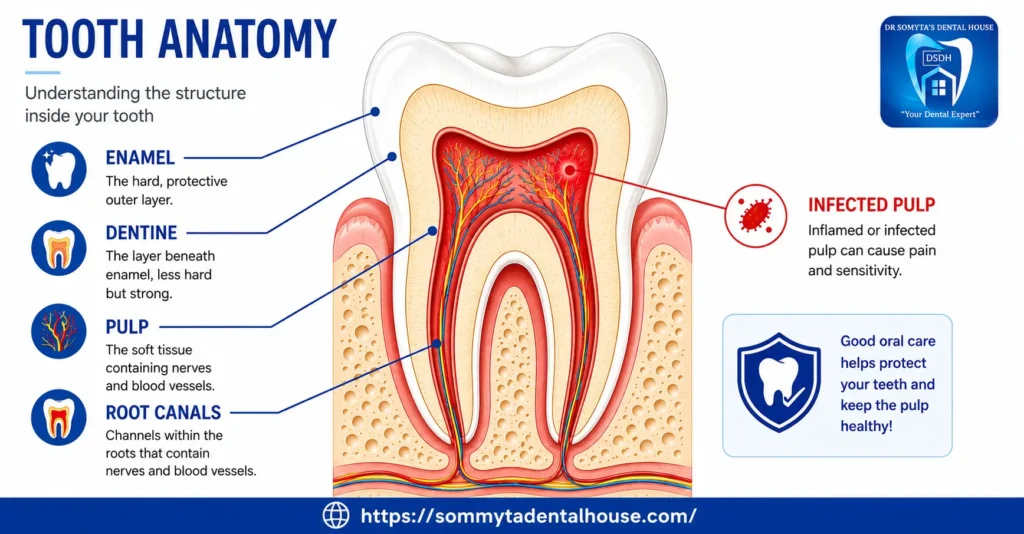
So what actually happens? Your tooth has layers. The outer hard part is enamel. Under that is dentine. And at the very core is the pulp soft tissue filled with nerves, blood vessels, and connective tissue. That pulp is what keeps a developing tooth alive. But once the tooth is fully grown, the pulp isn’t essential anymore. The tooth can survive perfectly well without it.
The problem happens when bacteria get into that pulp through a deep cavity, a crack, a chip, or old damaged dental work. Once bacteria reach the pulp, infection begins. And infected pulp means serious pain. Throbbing, radiating, keep you up at night pain.
Root canal treatment removes that infected pulp, cleans out the canals inside the root, seals everything up, and saves the tooth. That’s it. The tooth stays. The pain goes. Life continues.
And yet somehow, people would rather suffer for weeks than make an appointment.
Don’t be that person. Seriously.
Signs You Might Need Root Canal Treatment
Not every toothache needs a root canal. But certain symptoms almost always point in that direction. If you’re experiencing any of these, it’s time to stop guessing and get an X-ray done.
Persistent, throbbing pain that won’t quit — This isn’t the kind of dull ache you get from sensitivity. This is deep, relentless pain. Sometimes it gets worse at night when you lie down. Sometimes it radiates to your jaw, your ear, even your head. If that sounds familiar, the pulp is likely involved.
Sensitivity that lingers way too long — Everyone gets a bit of sensitivity with cold or hot food. But if the sensitivity lasts more than 30 seconds after the stimulus is gone, that’s your nerve telling you something is wrong.
Swelling in the gum or face — Swelling that doesn’t go down, especially around a specific tooth, often means infection is spreading. This is serious and needs attention quickly.
A pimple-like bump on the gum — This is called a dental abscess. It’s the body trying to drain the infection. If you see this, don’t wait.
Tooth discoloration — A tooth turning dark grey or brownish is often a sign the pulp inside has died or is dying.
Pain when biting or chewing — Not just sensitivity. Actual pain when you put pressure on the tooth.
A cracked or chipped tooth with pain — Cracks let bacteria in. If a damaged tooth is painful, the pulp may already be compromised.
One thing worth noting: sometimes a tooth that needs root canal treatment has no pain at all especially if the pulp is dead. The only way to know for certain is through an X-ray and professional evaluation. Which is why if you’re in Bengali Square or nearby, walking into a dental clinic for a check is genuinely the smartest move you can make.
Also Read : Best Dental Clinic Near Bengali Square, Indore | Advanced Dental Care
How Root Canal Treatment Actually Works | Step by Step
Here’s what happens when you come in for root canal treatment at a clinic near Bengali Square, Indore. No mysteries, no scary surprises.
Step 1: Consultation and X-Ray
You sit down, the dentist talks to you about your symptoms, and a digital X-ray is taken. This shows the shape of your root canals, how deep the infection has gone, and how many canals need to be treated. Front teeth usually have one canal. Premolars have one or two. Molars have three or four. The X-ray tells the dentist exactly what they’re working with.
This step takes maybe 15-20 minutes and there’s no discomfort at all.
Step 2: Local Anaesthesia
Before anything else happens, the dentist numbs the area around your tooth. This is a small injection and yes, the injection can be a bit uncomfortable for a few seconds. But it’s not the monster people imagine. Within a couple of minutes, the entire area is completely numb.
This is where most of the “root canal is terrible” fear should stop. Because after the anaesthesia kicks in you feel nothing. Pressure, maybe. Vibration from the instruments. But no pain.
Step 3: Rubber Dam Placement
A small rubber sheet called a dental dam is placed around the tooth to keep it dry and isolated from saliva during the procedure. It sounds weird but you won’t really notice it’s there.
Step 4: Opening the Tooth
The dentist drills a small access hole in the top of the tooth to reach the pulp chamber inside. Since you’re numb, you feel nothing beyond a faint vibration.
Step 5: Removing the Infected Pulp
Using very fine instruments, some manual, some rotary (machine-driven) the dentist carefully removes all the infected and inflamed pulp from the tooth and the root canals. The canals are then shaped so they can be filled properly later.
This is the longest part of the procedure, but again numb, no pain.
Step 6: Cleaning and Disinfecting
The canals are thoroughly flushed with antiseptic solutions to kill any remaining bacteria. This is a critical step because any bacteria left behind can lead to re-infection later.
Step 7: Filling and Sealing
Once the canals are clean and shaped, they’re filled with a rubber-like material called gutta-percha. The access opening is then sealed with dental cement.
Step 8: Crown Placement (follow-up visit)
The final step and one that people sometimes skip, which is a mistake, is getting a dental crown placed over the treated tooth. A root canal-treated tooth becomes more brittle over time because it no longer has a blood supply. A crown protects it from cracking under the pressure of chewing.
The crown appointment usually happens 1-2 weeks after the root canal.
Total time: 45 minutes to 1.5 hours per visit, depending on complexity. Number of visits: 1 to 3, depending on infection severity and tooth location.
Sommyta Dental House | Root Canal Treatment in Bengali Square, Indore
If you’re specifically looking for root canal treatment in Bengali Square, Indore, Dr. Sommyta’s Dental House is the name that comes up consistently among local residents.
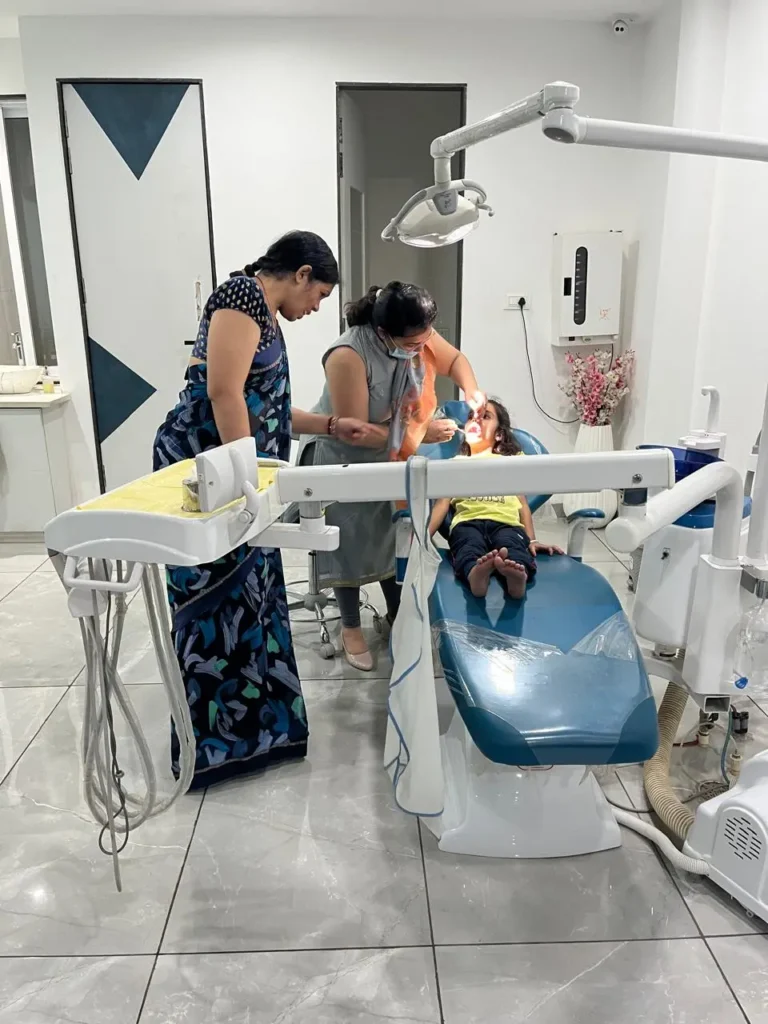
Here’s why patients from Bengali Square, Vijay Nagar, and Ashish Nagar keep coming back and sending their families:
The clinic uses digital X-rays for accurate diagnosis, rotary endodontic instruments for smoother, faster root canal treatment, and autoclaved (sterilised) instruments for every single procedure. The team explains everything in plain language before doing anything, which makes a huge difference for anxious patients.
Dr. Sommyta has over 10 years of experience in dental care, and the clinic’s 4.8-star Google rating reflects real patient feedback not a number pulled out of thin air.
Perhaps most importantly for Bengali Square residents: they offer a FREE first consultation. You can come in, get your tooth checked, understand exactly what’s happening, know the cost upfront and then decide. No pressure, no confusion.
Address: 29A, Ashish Nagar Road, Ashish Nagar, Indore, Madhya Pradesh — 452016
Call / WhatsApp: +91 94528 16183
Website: www.sommytadentalhouse.com
Root Canal Treatment Cost in Bengali Square, Indore | Honest Numbers
Cost is one of the first things people want to know, and one of the things dental clinics are most vague about. Let’s be direct.
Root canal treatment cost in Indore depends on which tooth is being treated (because the number of root canals varies), the severity of the infection, and whether a crown is included or separate.
Here are realistic price ranges for dental clinics in the Bengali Square and Ashish Nagar area:
Single canal RCT (front teeth): ₹2,500 – ₹4,500
Bi-canal RCT (premolars): ₹3,500 – ₹6,000
Multi-canal RCT (molars, back teeth): ₹5,000 – ₹9,000
PFM Crown (standard, good quality): ₹3,000 – ₹5,500
Zirconia Crown (premium, looks most natural): ₹6,000 – ₹12,000
Re-treatment RCT (previously done, now failing): ₹6,000 – ₹12,000
So for a molar root canal plus a crown the most common combination you’re looking at is roughly ₹8,000 to ₹14,000 at a quality clinic near Bengali Square. That’s the honest answer.
A few things to keep in mind about cost:
If a clinic quotes you ₹1,000 for a molar root canal, ask questions. That kind of price usually means compromises somewhere reused instruments, poor quality filling material, or skipping steps. Cheap dental work often leads to re-treatment costs that far exceed what you would have paid for quality work the first time.
At the same time, you shouldn’t have to pay ₹20,000 for a standard molar RCT in Indore. That’s on the high end for this city.
Sommyta Dental House operates specifically on the principle of making quality dental care affordable their tagline is literally “Get a Dazzling Smile at Lowest Price.” You get a written estimate before treatment starts, so there are no surprises when you’re handed the bill.
Also Read : Best Dental Braces Doctor Near Bengali Square, Indore 2026 for Safe & Effective Treatment
Why Extracting the Tooth Is Almost Never the Better Option
This comes up a lot. “Why not just pull it out? It’s cheaper and faster.”
On the surface, yes an extraction is often cheaper at the moment. But what happens after?
You now have a gap in your mouth. That gap does things. The neighbouring teeth start tilting into the empty space over time. The tooth above (or below) the gap starts growing down (or up) into the empty space because there’s nothing to bite against. Your bite changes. Your jaw alignment can shift. You may start getting headaches and jaw pain (TMJ problems) years down the line.
And then there’s the bone. Your jawbone stays healthy because of the pressure created by tooth roots when you chew. Remove the root, and the bone in that area starts slowly shrinking a process called bone resorption. Over years, this changes the shape of your face.
To fix all of this, you’d need an implant which costs anywhere from ₹25,000 to ₹60,000 in Indore. Or a bridge, which requires grinding down perfectly healthy adjacent teeth.
Root canal treatment even if it costs ₹10,000 is almost always the financially smarter and medically better choice. You keep your natural tooth, your bone, your bite, and your face shape.
The only time extraction makes sense is when the tooth is so damaged or the bone loss is so severe that saving it is genuinely not possible. A good dentist will tell you honestly when that’s the case. If a dentist suggests extraction for a tooth that could be saved with RCT get a second opinion.
Real Experiences | What Patients Near Bengali Square Say
Reading about a procedure is one thing. Hearing from someone who has actually been through it hits differently. Here are honest accounts from patients in and around Bengali Square, Indore:
“I had tooth pain for almost a month. I kept taking painkillers and telling myself it would pass. It didn’t. One of my colleagues from Vijay Nagar told me to go to Sommyta Dental House. I went in, a little scared honestly. Dr. Sommyta took one look at the X-ray and explained clearly that the pulp was infected and I needed a root canal. The procedure itself kept waiting for the pain. It never came. Just some pressure and vibration. I walked out, had lunch an hour later. I genuinely couldn’t believe that was it.”
— Amit Kumar, 38, Vijay Nagar
“My daughter is 8 and she had an infected baby tooth. I was more scared than she was, honestly. The staff at Sommyta were genuinely kind; they spoke to her in a way that made her feel safe. The procedure (pulpectomy, they called it) went smoothly. She was eating normally by evening. The cost was also very reasonable. I’ve sent three people there since then.”
Sunita Mishra., 34, Bengali Square
“I had a root canal done somewhere else about 5 years ago. It started hurting again recently. Went to Sommyta Dental House and found out the previous treatment had failed incomplete cleaning, they said. They did a re-treatment. Yes, it cost a bit more, but it’s been 8 months now and the tooth is completely fine. I wish I’d gone to a proper place the first time.”
Deepak Dwivedi, Scheme 54
Aftercare | What to Do After Root Canal Treatment
The procedure is done. Now what?
First 24–48 hours:
- Avoid eating on the treated side of your mouth
- Stick to soft foods rice, dal, curd, soft roti
- Avoid very hot or very cold food and drinks
- Take any prescribed antibiotics exactly as directed complete the course
- Use the painkiller your dentist recommends (usually ibuprofen or paracetamol) if you feel sore. Some soreness for 2-3 days is completely normal
After the first few days:
- Mild discomfort should reduce significantly within 3 days
- If pain is increasing instead of decreasing call your dentist
- Avoid hard, crunchy foods until the permanent crown is placed
After the crown is placed:
- You can eat normally, including hard foods
- The tooth functions just like any other tooth
- No special maintenance beyond normal oral hygiene
Long-term:
- Brush twice a day
- Floss daily, especially around the crown
- Visit the dentist every 6 months for check-ups
A properly done root canal with a good crown can last 15–25 years or longer. Some treated teeth outlast the patient. But only if you keep up with basic oral hygiene and don’t skip your check-up appointments.
Also Read : Best & Painless Root Canal Treatment Near Me in Indore (2026 Guide)
Book Your Appointment at Sommyta Dental House | It’s Easier Than You Think
If this blog has told you one thing, hopefully it’s this: root canal treatment is not the monster it’s made out to be. The pain is manageable. The procedure is routine. And saving your tooth is almost always worth it.
The longer you wait, the worse the infection gets. Infections don’t stay in one place they spread to the bone, to neighbouring teeth, sometimes to other parts of the body. What starts as a ₹6,000 root canal can turn into a ₹40,000 implant situation if you leave it long enough.
If you’re in Bengali Square, Vijay Nagar, Ashish Nagar, Palasia, or anywhere in south or west Indore, Sommyta Dental House is right there.
Call / WhatsApp: +91 94528 16183
Address: 29A, Ashish Nagar Road, Ashish Nagar, Indore, Madhya Pradesh — 452016
Website: www.sommytadentalhouse.com
Frequently Asked Questions
Is root canal treatment painful?
No. It is done under local anaesthesia so there is no pain during the procedure. You may feel slight pressure but nothing sharp. Most patients say the toothache before treatment is far more painful than the root canal itself.
How much does root canal treatment cost in Bengali Square, Indore?
It starts from ₹2,500 for front teeth and goes up to ₹9,000 for molars. With a crown included, total cost is usually ₹8,000 to ₹14,000. Sommyta Dental House offers a free first consultation with a written cost estimate before treatment starts.
Is root canal treatment safe for children?
Yes. Children sometimes need a pulpectomy for baby teeth. It is safe and important losing baby teeth too early affects how permanent teeth grow in. Sommyta Dental House provides gentle paediatric dental care.
Is root canal better than extraction?
Yes, in almost all cases. Root canal saves your natural tooth, preserves jawbone, and keeps surrounding teeth aligned. Extraction leads to bone loss and replacing it with an implant costs ₹25,000 to ₹60,000 far more than a root canal.
How many visits are needed for root canal treatment?
Most cases are completed in 1 to 3 visits. Single-sitting root canals are common for straightforward cases. Severe infections or molars with multiple canals may need extra visits.