sommytadentalhouse

Blog

Your blog category

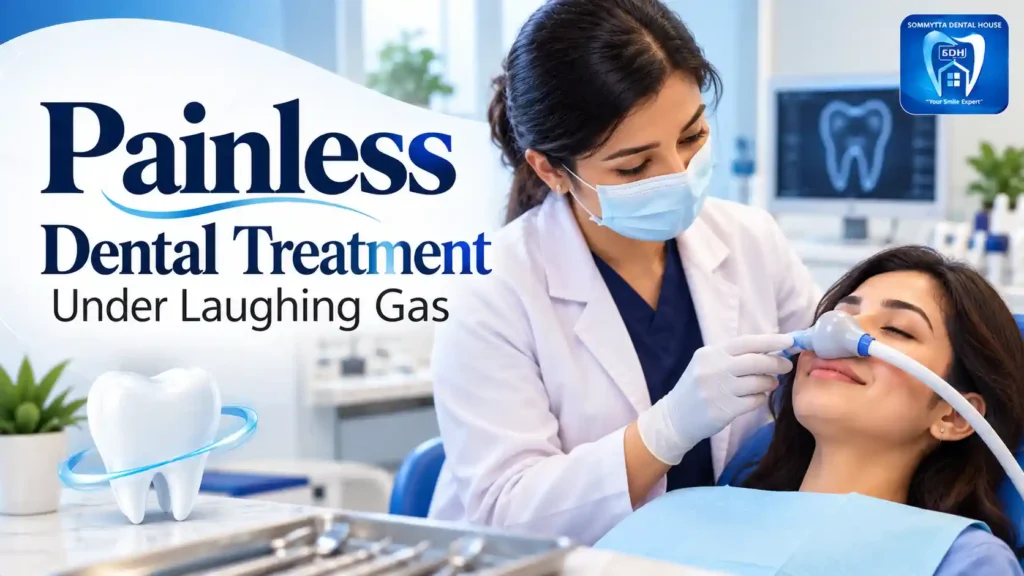
Painless dental treatment under laughing gas at Sommyta Dental House in Indore

Painless Dental Treatment Under Laughing Gas in Indore

If the thought of sitting in a dental chair makes your palms sweat, you’re not alone. A large number of patients who walk into Sommyta Dental House in Indore admit the same thing before their first appointment: “Doctor, mujhe dentist se dar lagta hai.” Dental fear is one of the most common reasons people delay treatment until a small cavity turns into a root canal, or a mild gum problem turns into something far more painful — a pattern that government oral health data for India has also flagged as a major reason for the country’s high burden of untreated dental disease. This is exactly where laughing gas, also known as nitrous oxide, has changed the way dentistry is practiced. At Sommyta Dental House, we’ve seen firsthand how a simple, safe, and well-monitored gas can turn a nervous, tense patient into someone who is calm enough to get treated without dreading every second of it. In this blog, we’ll walk you through what laughing gas actually is, how it helps during dental procedures, who it’s suitable for, and why more dentists in Indore — including our team — are recommending it for anxious patients, children, and even routine treatments that people have been avoiding for years. What Is Laughing Gas in Dentistry? Laughing gas is the common name for nitrous oxide, a colorless, mildly sweet-smelling gas that has been used in dentistry and medicine for well over a century. It’s mixed with oxygen and given to the patient through a small nasal mask that sits comfortably over the nose during the procedure. Once inhaled, nitrous oxide works quickly, usually within a few minutes, to produce a light, relaxed, almost floaty feeling. Patients often describe it as a sense of calm — some even find themselves smiling or giggling a little, which is how the gas got its playful nickname. Unlike general anesthesia, the patient stays fully conscious and aware throughout the treatment, able to respond to the dentist and breathe entirely on their own. What makes laughing gas particularly popular in modern dental clinics, including ours at Sommyta Dental House, is how controllable and short-acting it is. The dentist can adjust the concentration in real time depending on how relaxed or alert the patient needs to be, and once the mask is removed, the effects wear off within minutes. Also Read : Bleeding Gums While Brushing | Causes, Symptoms & Treatment in Indore How Does Laughing Gas Help During Dental Treatment? Most people assume dental fear is only about pain, but in reality, it’s often about the anticipation of pain — the sound of the drill, the feeling of instruments in the mouth, or simply not being in control of the situation. Laughing gas addresses this anxiety directly. Here’s how it typically helps during a dental visit at Sommyta Dental House: It’s worth being clear here: laughing gas itself is not a painkiller in the way local anesthesia is. Its main role is to calm the mind and reduce the perception of discomfort, while the numbing injection handles the actual pain control at the treatment site. Together, they make the overall experience significantly more comfortable than treatment without any sedation support. Is Dental Treatment Under Laughing Gas Painless? This is probably the most common question we get at Sommyta Dental House, so let’s answer it honestly. No responsible dental clinic can promise a completely pain-free experience for every single patient in every single situation — bodies and pain thresholds differ, and some procedures naturally involve more sensation than others. What we can say, based on years of clinical experience, is that laughing gas helps make treatment considerably more comfortable by reducing anxiety, easing muscle tension, and taking the “edge” off the entire visit. Combined with proper local anesthesia — which is still used to numb the specific area being treated — most patients under laughing gas report barely noticing the procedure at all. Many describe it as one of the calmest dental visits they’ve had. So while we avoid making absolute claims like “100% painless,” what we can confidently say is that it is one of the most effective, safe tools available today for anxious patients who want a smoother, gentler treatment experience. Who Can Benefit From Laughing Gas During Dental Treatment? Laughing gas isn’t reserved for only the most fearful patients — it’s suitable for a wide range of people. At Sommyta Dental House, we usually recommend it for: Patients with dental anxiety or phobia — If you’ve avoided the dentist for years because of fear, laughing gas can make it possible to finally get the treatment you need without the dread. Children undergoing kids’ dentistry — Kids often struggle to sit still or stay calm during procedures. Laughing gas is widely used in pediatric dentistry because it’s gentle, quick-acting, and wears off fast, letting children go back to their normal activities soon after. Patients with a strong gag reflex — For people who find it hard to tolerate instruments or impressions in their mouth, the relaxed state induced by laughing gas can make the process much more manageable. Patients undergoing longer procedures — Treatments like root canal therapy or multiple extractions in one sitting can feel mentally exhausting. Laughing gas helps patients stay relaxed through longer chair time. First-time patients — If you’re visiting a dentist for the first time in years (or ever), laughing gas can help ease you into the experience without overwhelming anxiety. That said, it’s not automatically suitable for everyone. Patients with certain respiratory conditions, some pregnant patients, or those on specific medications should discuss their medical history with the dentist beforehand. At Sommyta Dental House, we always review your health history before recommending any sedation option, including laughing gas. What Dental Treatments Can Be Done Under Laughing Gas? One of the biggest advantages of laughing gas is how versatile it is. It can be used across a wide range of procedures we offer at Sommyta Dental House, including: Essentially, if a procedure

Painless Dental Treatment Under Laughing Gas in Indore Read More »
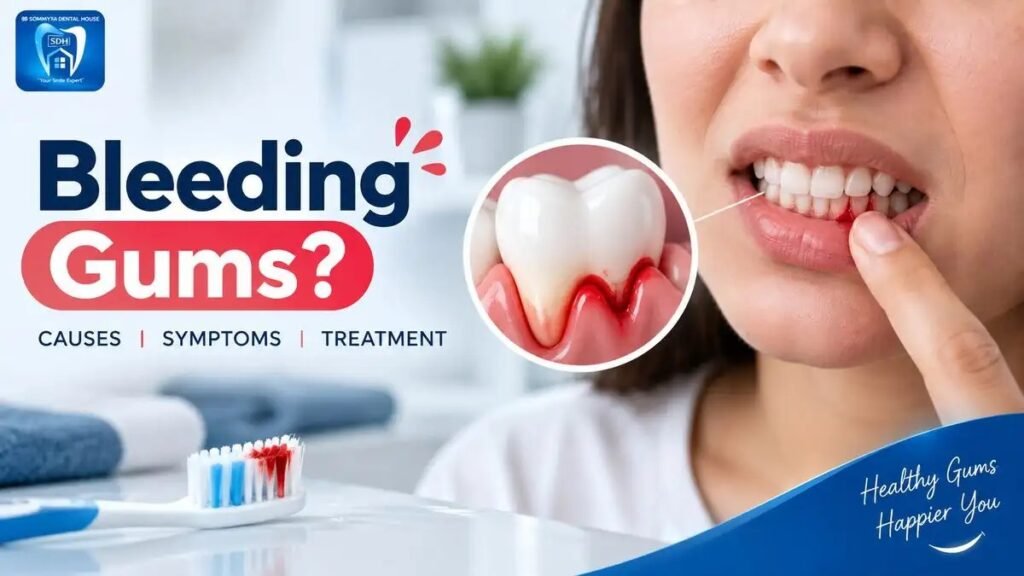
Bleeding gums while brushing causes symptoms and treatment in Indore

Bleeding Gums While Brushing | Causes, Symptoms & Treatment in Indore

Brushing your teeth is supposed to be a simple, everyday habit  not something that leaves pink or red on your toothbrush. Yet a lot of people spit out blood while brushing and just shrug it off, thinking it will go away on its own. Sometimes it does. Sometimes it doesn’t, and it’s actually your gums trying to tell you something. Occasional, mild bleeding can happen if you brushed a little too hard, or if you just started flossing after months of not doing it. That’s usually nothing to panic about. But when your gums bleed almost every time you brush, or the bleeding keeps coming back week after week, it’s often connected to gum inflammation or early gum disease that needs attention rather than time. If you live in Indore and this has been happening to you for a while, this guide walks you through why it happens, what symptoms to watch for, and when it’s time to actually see a dentist instead of waiting it out. Clinics such as Sommyta Dental House in Indore see this complaint fairly often, and in most cases, it’s very treatable once it’s caught early. Quick Answer Why do gums bleed while brushing? The most common reason is plaque buildup along the gumline, which irritates the gum tissue and causes inflammation known as gingivitis. Brushing too hard, using a hard-bristled brush, vitamin deficiencies, hormonal changes, and smoking can also cause bleeding gums. If bleeding continues for more than a week despite gentle brushing, it’s advisable to get a dental checkup, since untreated gum inflammation can progress to periodontitis, a more serious form of gum disease. Why Do Gums Bleed While Brushing? There isn’t just one reason gums start bleeding  it’s usually a combination of how you’re brushing and what’s happening under the gumline. Here are the most common causes dentists come across. Plaque and Tartar Buildup Every day, a thin, sticky film called plaque forms on your teeth. It’s made up of bacteria, food particles, and saliva. If you brush and floss well, most of it comes off. But if plaque is left sitting near the gumline for too long, it hardens into tartar (also called calculus), which a toothbrush simply cannot remove. This buildup irritates the gum tissue right where it meets the tooth. The gums become inflamed, more sensitive, and start to bleed the moment you brush over them  even gently. This is, by far, the single biggest reason people experience bleeding gums. Brushing Too Hard Ironically, brushing harder doesn’t clean your teeth better  it just damages your gums. A hard-bristled toothbrush combined with aggressive scrubbing can wear down the gum tissue, making it thinner and more prone to bleeding. Over time, this can also contribute to gum recession, which is a separate problem on its own. Gum Infection and Inflammation When plaque isn’t cleaned properly for an extended period, the gum tissue reacts by becoming red, puffy, and tender. This is called gingivitis  the earliest and mildest form of gum disease. At this stage, bleeding is one of the clearest warning signs, and the good news is that gingivitis is fully reversible with proper cleaning and better home care. Common Symptoms That May Occur With Bleeding Gums Bleeding rarely shows up completely on its own. It’s usually accompanied by a few other signs that, together, give a clearer picture of what’s going on. Red or Swollen Gums Healthy gums are usually a pale pink and firm to the touch. When gums turn red or look puffy along the edges, it’s a sign of inflammation. Tender or Painful Gums Some people notice mild soreness while eating or brushing, especially around the same spots that bleed. Persistent Bad Breath Bacteria trapped under the gumline and in plaque produce a smell that doesn’t go away with mouthwash or mints  it keeps returning because the source hasn’t been treated. Receding Gums Over time, inflamed or infected gums can start pulling away from the tooth surface, making teeth look slightly longer than before. Loose Teeth or Changes in Tooth Position This is usually a later-stage symptom and suggests the bone and tissue supporting the teeth have already been affected. It’s a strong signal that professional treatment shouldn’t be delayed further. If you’re also dealing with sharp discomfort when eating something cold or sweet, it’s worth reading our guide on sensitive teeth treatment near Bengali Square, since gum recession and sensitivity often show up together. Can Bleeding Gums Be a Sign of Gum Disease? This is the question most people are actually trying to answer when they search for bleeding gums online  and the honest answer is: sometimes, yes. Gingivitis – The Early Stage of Gum Disease Gingivitis happens when plaque along the gumline causes inflammation. It’s extremely common, and the encouraging part is that it’s completely reversible. With consistent brushing, flossing, and a professional cleaning to remove buildup a toothbrush can’t reach, gums usually return to normal within a couple of weeks. The mistake most people make is ignoring it because it “doesn’t hurt.” Gingivitis on its own is rarely painful, which is exactly why it tends to go unnoticed until it progresses further. Periodontitis – Advanced Gum Disease If gingivitis isn’t treated, the inflammation can spread deeper and start affecting the structures that actually hold your teeth in place  the ligaments and the bone underneath. This stage is called periodontitis. Unlike gingivitis, periodontitis can cause permanent damage: gum recession, bone loss around the teeth, and in more advanced cases, loose teeth that may eventually need extraction. According to the National Institute of Dental and Craniofacial Research (NIDCR), periodontal disease is largely preventable through good oral hygiene and regular dental visits, but it does require professional treatment once it sets in  it won’t resolve with brushing alone. This is really the key difference: gingivitis can often be managed and reversed at home with better habits, while periodontitis needs a dentist’s involvement. Other Possible Causes of Bleeding Gums Not every case of bleeding gums is about

Bleeding Gums While Brushing | Causes, Symptoms & Treatment in Indore Read More »

Conscious sedation for kids in Indore for comfortable pediatric dental care at Sommyta Dental House

Conscious Sedation for Kids in Indore | Comfortable Pediatric Dental Care

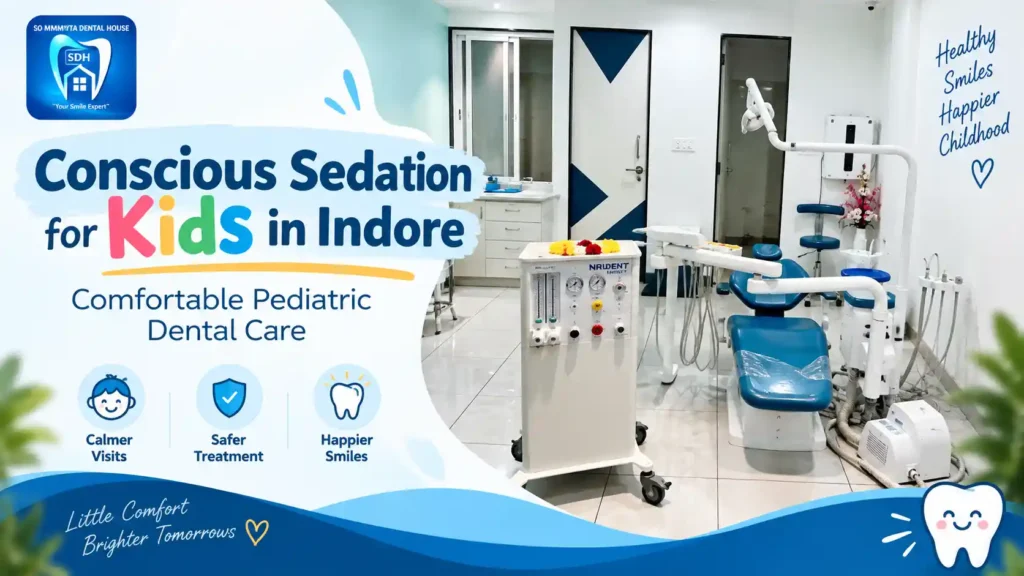
A trip to the dentist can feel scary for a lot of children. The sound of the drill, the bright light, or simply sitting still in a new chair can make a child nervous, and that nervousness sometimes turns into full-on fear. For parents, this can make even a simple checkup feel like a battle. This is where conscious sedation can help. It is used to make the treatment experience calmer and more manageable for children who find it hard to cope with dental visits. At Sommyta Dental House, Indore, conscious sedation is offered as one of the options available to help children get through dental treatment more comfortably, based on a proper assessment by the dental team. It is important to understand that conscious sedation is not used for every child or every visit. It is considered in suitable cases, after the dentist evaluates the child’s age, health history, and treatment needs. This article explains what conscious sedation is, when it may be used, how it is different from general anesthesia, and what parents can expect during the process. What Is Conscious Sedation for Kids? Conscious sedation is a technique used in dentistry to help a child feel more relaxed during a dental procedure. Depending on the level of sedation used, the child usually stays conscious and responsive, meaning they can still breathe on their own and respond to questions or simple instructions from the dental team. The main purpose of conscious sedation is to reduce anxiety and discomfort, not to put the child to sleep completely. It is meant to make the treatment experience smoother, especially for children who struggle to stay still or who feel very anxious in a dental setting. It is worth repeating that conscious sedation and general anesthesia are not the same thing. General anesthesia puts the child into a deep, sleep-like state where they are completely unaware of what is happening. Conscious sedation, on the other hand, keeps the child in a lighter, more responsive state. We will look at this difference in more detail a little later in this article. In simple words, conscious sedation is a way to help manage dental anxiety in children, support comfortable dental treatment, and make pediatric sedation a smoother process for both the child and the parent. Why Do Some Kids Need Sedation During Dental Treatment? Not every child needs sedation for a dental visit. Many children sit through checkups and simple treatments without any trouble. But for some children, certain situations can make treatment difficult without additional support. This section looks at some of the common reasons. Dental Anxiety and Fear Some children feel nervous the moment they see a dental chair or hear a dental instrument. This fear can come from a previous uncomfortable visit, stories they have heard, or simply from being in a new and unfamiliar place. When anxiety is high, it can be hard for the child to cooperate, even for a simple cleaning. Difficulty Sitting Through Treatment Younger children, or children who find it hard to stay still for long periods, may struggle to sit through a treatment that takes more than a few minutes. Movement during treatment can make it harder for the dentist to work safely and accurately. Strong Gag Reflex Some children have a naturally strong gag reflex, which can make procedures involving X-rays, impressions, or work at the back of the mouth uncomfortable for them. This can make even routine treatment feel difficult. Longer or More Involved Dental Procedures Certain treatments simply take more time or involve more steps than a basic checkup. In such cases, helping the child stay calm and comfortable for the full duration of the visit becomes more important. According to AAPD behavior guidance, factors such as a child’s anxiety level, ability to cooperate, the type of treatment needed, and their previous dental experiences are all considered part of an individualized behavior guidance plan. This means the decision to use sedation, or any other approach, is never a one-size-fits-all choice. It is based on what suits that particular child. How Does Conscious Sedation Help During Dental Treatment? When used appropriately, conscious sedation can support a more positive dental visit in a few ways: For example, nitrous oxide combined with oxygen is a technique recognised by the American Academy of Pediatric Dentistry (AAPD) as a way to help reduce anxiety and provide analgesia in appropriate pediatric patients. It has been used in pediatric dentistry for many years and is considered one of the more commonly used sedation options for children. It is important to be honest here. Conscious sedation is not a guarantee of a completely pain-free or fear-free experience for every child, and no responsible dental practice should claim that any treatment is “100% painless” or “completely safe for every child.” Every child responds differently, and outcomes depend on the individual case. What conscious sedation does offer is a way to manage anxiety and discomfort more effectively in suitable situations, based on professional assessment. Is Conscious Sedation Suitable for Every Child? This is one of the most important questions parents should ask, and the honest answer is no. Conscious sedation is not automatically suitable or necessary for every child who visits the dentist. Before recommending sedation, the dentist looks at several factors, including: Based on this assessment, the dentist decides whether sedation is appropriate, and if so, which method may suit the child best. This is why the same approach cannot be applied to every patient. Some children may only need simple behavior guidance techniques, such as a calm explanation of the procedure or a distraction technique, while others may benefit from a sedation option. Parents should always feel comfortable discussing the risks, benefits, and alternatives with the dentist before deciding on any sedation method for their child. A good dental team will take the time to explain these clearly rather than rushing into a decision. AAPD’s guidance on pediatric sedation places strong emphasis on a pre-sedation evaluation, appropriate monitoring during

Conscious Sedation for Kids in Indore | Comfortable Pediatric Dental Care Read More »

Sommyta Dental House dentist examining a child for oral habits and dental development

Common Oral Habits in Children | How They Affect Dental Development

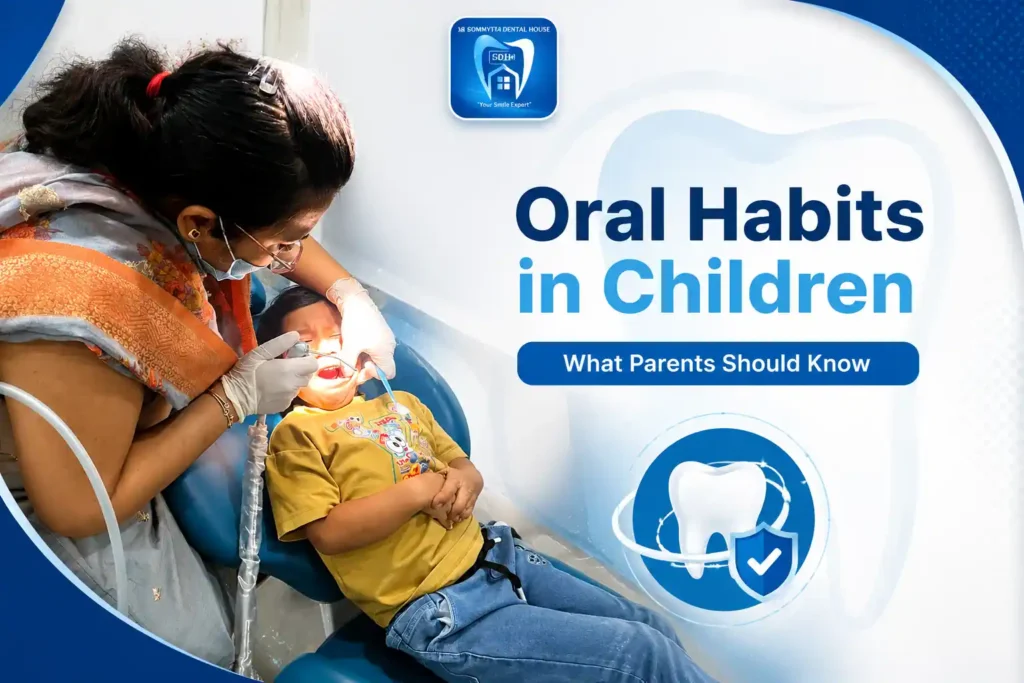
Thumb sucking, mouth breathing, tongue thrusting, and teeth grinding are some of the most common oral habits in children. Most of these habits are a normal part of early childhood and fade away on their own. The concern is not the habit itself but how long it continues, how often it happens, and how forcefully it is done. A habit a toddler outgrows by age three looks very different from the same habit continuing at age seven, once permanent teeth start coming in. This is when persistent oral habits can start to influence tooth alignment and jaw development, which is why parents are often advised to consider an early dental evaluation once a habit continues past the age it would normally stop. Which Oral Habits Can Affect a Child’s Dental Development? Children can develop several different oral habits, and each one affects the growing mouth in its own way. Understanding what each habit involves, and how it is different from the next, makes it easier for parents to know what is normal and what deserves a closer look from a dentist. Thumb Sucking and Its Effects on Children’s Teeth Thumb sucking is one of the most recognisable oral habits in early childhood, and it is completely normal in infants and toddlers. Some babies even suck their thumb before birth. It gives young children a sense of comfort and security, and many turn to it instinctively when they are tired, bored, or adjusting to something new, such as starting daycare or a new sibling arriving at home. In most children, thumb sucking effects on teeth are minimal because the habit itself is short-lived. It is generally considered normal up to around age two to four, and as a child’s ability to self-soothe develops, the thumb sucking habit usually fades on its own without leaving any lasting mark on the teeth. Problems tend to appear when the habit continues after the front permanent teeth begin to erupt, generally from around age six onward. Persistent, forceful thumb sucking places steady pressure on the front teeth and the roof of the mouth. Over time, this pressure can lead to an open bite, where the upper and lower front teeth do not meet when biting down, or to protruding front teeth and a narrower upper arch. The intensity of the sucking matters a great deal here. A child who rests the thumb passively in the mouth is far less likely to see these changes than a child who sucks vigorously and frequently. This connection between thumb sucking and dental development has been studied extensively, and dental professionals generally agree that the duration and intensity of the habit, rather than its mere presence, determine the outcome. Parents can gently discourage the habit by praising the child during periods without thumb sucking, addressing the underlying reason for it such as anxiety or a need for comfort, and involving the child in age-appropriate ways to stop it, such as a simple reward chart. If the habit continues beyond age four, or if changes in tooth position are already visible, it is a good time to speak with a pediatric dentist. Mouth Breathing in Children: Can It Affect Dental and Facial Development? Mouth breathing in children happens when a child breathes primarily through the mouth instead of the nose, both while awake and during sleep. It is often easy for parents to miss at first, since it can look like a simple habit rather than a sign of something else happening in the airway. Common signs of a child breathing through the mouth include sleeping with the mouth open, snoring, a dry mouth on waking, cracked or chapped lips, and a general preference for mouth breathing even while resting quietly during the day. Some children develop this pattern because their nasal airway is partially blocked, whether from seasonal allergies, enlarged tonsils or adenoids, or ongoing nasal congestion that has turned into a long-term habit rather than an occasional cold symptom. Chronic mouth breathing does not only affect how a child takes in air. Because the tongue rests differently in the mouth during mouth breathing compared to normal nasal breathing, it can gradually influence how the jaw and palate grow, and prolonged mouth breathing has been linked to changes in facial development in children, including a longer, narrower facial profile in some cases. This is one of the more overlooked mouth breathing dental problems, since the effect builds up slowly and is not always obvious in the early stages. Because of this, mouth breathing should never simply be dismissed as a bad habit that a child will grow out of. It often points to an underlying airway issue that benefits from a proper evaluation, whether from a dentist, a pediatrician, or an ENT specialist, depending on the underlying cause. Tongue Thrusting and Its Impact on Teeth Alignment Tongue thrusting in children refers to a swallowing pattern where the tongue pushes forward against or between the teeth, rather than pressing up against the roof of the mouth the way it should during a normal swallow. Because swallowing is an automatic action that happens dozens of times a day, even a mild tongue thrust habit repeats itself constantly. This repetition is exactly why a persistent tongue thrust can gradually affect teeth alignment. The forward pressure on the front teeth, applied thousands of times over months and years, can contribute to an open bite or noticeable spacing between the upper front teeth. Tongue thrusting effects on teeth are often similar to those seen with prolonged thumb sucking, since both involve sustained pressure on the same group of teeth. Abnormal tongue movement in children is also sometimes associated with speech concerns, particularly with sounds like “s” and “z,” since the position of the tongue plays a direct role in how these sounds are formed. Tongue thrusting frequently overlaps with other oral habits, such as prolonged thumb sucking or mouth breathing, so a dentist evaluating one habit will usually check for the others as

Common Oral Habits in Children | How They Affect Dental Development Read More »

Sedation Dentistry Near Me in Indore thumbnail featuring a relaxed dental patient receiving safe and comfortable treatment at Sommyta Dental House near Bengali Square, Kanadia Road, and Tilak Nagar.

Sedation Dentistry Near Me in Indore

If you’re searching for sedation dentistry near me in Indore, you’re probably looking for a comfortable and stress-free dental experience. Many children and adults delay treatment because of dental fear. At Sommyta Dental House, patients receive personalized dental care focused on comfort, safety, and modern treatment options. Conveniently located near Bengali Square, Kanadia Road, and Tilak Nagar in Indore, the clinic offers a patient-first approach to help make dental visits more relaxed and stress-free. What Is Sedation Dentistry? Sedation dentistry is an approach that helps patients stay calm and comfortable during dental procedures. Instead of feeling tense or fearful in the chair, patients experience a sense of relaxation during treatment, making even longer or more complex procedures easier to manage. The goal of sedation dentistry is simple: comfortable dental care without the stress that usually comes with a dental visit. Depending on the level of anxiety and the treatment required, a dentist may recommend conscious sedation, which keeps the patient relaxed while still able to respond and communicate throughout the procedure. This makes anxiety-free treatment possible for people who would otherwise avoid the dentist altogether. Who Can Benefit from Sedation Dentistry? Sedation dentistry isn’t only for people with severe dental phobia. It can help a wide range of patients feel more at ease during treatment. People Who Can Benefit Include: Also Read : Prevention Is Better Than Filling | Fluoride Treatment Kyu Zaruri Hai? Types of Sedation Used in Dentistry There are different levels of sedation, and the right option depends on the patient’s anxiety level, medical history, and the treatment being performed. Nitrous Oxide (Laughing Gas) Nitrous oxide is a mild, inhaled sedation option that helps patients relax within minutes. It wears off quickly, allowing most patients to resume normal activities soon after their appointment. This makes it a popular choice for both children and adults with mild to moderate anxiety. Oral Sedation Oral sedation involves taking a prescribed medication before the appointment to help the patient feel calm and relaxed. This option is often used for patients with moderate dental anxiety or those undergoing longer procedures. IV Sedation For certain cases, IV sedation may be considered to achieve a deeper level of relaxation. This option is generally reserved for specific situations and is planned carefully as part of an individual treatment plan. Is Sedation Dentistry Safe? Patient safety is the top priority whenever sedation is used. Before recommending any form of sedation, an experienced dentist will carry out a thorough patient evaluation. Safety Measures Include: When these precautions are followed, sedation dentistry is considered a safe and effective way to manage dental anxiety. What Dental Treatments Can Be Done Under Sedation? Sedation can be used across a wide range of dental treatments, helping patients complete necessary procedures without added stress. Common Treatments Performed Under Sedation: Whether it’s a routine dental cleaning near me search or a more involved procedure like a root canal treatment near me, sedation can make the experience noticeably more comfortable. Sedation Dentistry for Children Dental visits can feel overwhelming for young children, especially if they’ve had a difficult experience before. This is where a pediatric dentist trained in fear-free dental care can make a real difference. Parents searching for a kids dentist near me or a children’s dentist often want reassurance that their child will feel safe and calm. Sedation options for child dental care help reduce fear, prevent panic during treatment, and support better cooperation, allowing the dentist to complete procedures more efficiently while keeping the child comfortable throughout. Also Read : Best Paediatric Dentist Near Bengali Square, Indore | Safe Sedation Technique for Kids Sedation Dentistry for Adults Adults deal with dental anxiety just as often as children, sometimes even more so due to past experiences or dental phobia developed over the years. Sedation Can Help Adults With: By addressing these challenges, sedation dentistry allows adults to receive timely, necessary care instead of postponing treatment out of fear. Signs You May Need Sedation Dentistry Not everyone realizes that their discomfort with dental visits could be eased with sedation. Here are some common signs to watch for: If any of these sound familiar, it may be worth discussing sedation options with your dentist. What Happens During a Sedation Dentistry Appointment? Understanding the process can help ease some of the uncertainty around sedation dentistry. Here’s what a typical appointment looks like: Step-by-Step Process: This structured approach ensures every patient receives care suited to their comfort and safety needs. Benefits of Sedation Dentistry Sedation dentistry offers more than just a calmer appointment. It can genuinely change how patients experience dental care. Key Benefits Include: How to Prepare Before Sedation Dentistry? A little preparation goes a long way in making your sedation appointment smooth and safe. Preparation Tips: Also Read : Dental Implant Cost in Indore (2026) Sedation Dentistry vs Local Anesthesia Patients often wonder how sedation dentistry differs from local anesthesia. Here’s a simple comparison: Aspect Sedation Dentistry Local Anesthesia Purpose Reduces anxiety and promotes relaxation Numbs a specific area to prevent pain Awareness Patient is relaxed, often conscious Patient is fully awake and aware Best For Anxious patients, longer or multiple procedures Simple, short procedures Recovery Time May require some rest, depending on type Usually minimal, quick recovery Combined Use Often used along with local anesthesia Can be used independently In many cases, sedation dentistry and local anesthesia are used together, allowing patients to stay relaxed while the treated area remains numb and pain-free. When Should You Visit a Sedation Dentist? If you live near Bengali Square, Kanadia Road, Tilak Nagar, Ashish Nagar, or nearby areas of Indore, and avoid dental treatment because of fear or anxiety, discussing sedation options with your dentist may help you receive timely care more comfortably. Delaying treatment often makes dental problems worse, so reaching out early is usually the better choice. Why Choose Sommyta Dental House? Sommyta Dental House has been providing dental care in Indore for over 10 years, with a strong focus on patient comfort

Sedation Dentistry Near Me in Indore Read More »

Attractive thumbnail for Fluoride Treatment Cavity Prevention Guide in Indore featuring Sommyta Dental House logo, a healthy protected tooth with shield, fluoride application graphic, and cavity prevention concept.

Prevention Is Better Than Filling | Fluoride Treatment Kyu Zaruri Hai?

“Agar ₹500–1000 ka preventive treatment aapko future me Root Canal, Tooth Filling ya Tooth Extraction se bacha sakta ho, to kya aap uske baare me jaanana nahi chahenge?” Sochiye – itni chhoti si investment, itna bada fayda. Yahi kaam karta hai Fluoride Treatment. Zyada tar log dental clinic tab jaate hain jab dard shuru ho jaata hai, lekin asli smart approach ye hai ki cavity hone ka wait hi na kiya jaaye. Daanton ko pehle se hi strong bana diya jaaye taaki wo problem aaye hi na. Isi soch ka naam hai preventive dentistry, aur fluoride treatment iska sabse simple aur effective tareeka hai. Is blog me hum detail me samjhenge ki fluoride treatment kya hota hai, ye kaam kaise karta hai, kise iski zarurat hai aur Indore me kahan se karwaya jaa sakta hai. Cavity Hone Ka Wait Kyu Nahi Karna Chahiye? Cavity ek raat me nahi hoti. Ye ek slow process hai jo dheere-dheere daant ke andar badhti rehti hai, aur yahi sabse badi problem hai – shuru me isme dard bilkul nahi hota. Jab tak pain feel hota hai, tab tak decay kaafi deep pahunch chuki hoti hai. Isliye jab tak aapko khud symptoms feel hote hain, situation kaafi aage badh chuki hoti hai: Iska matlab simple hai – agar aap early stage me hi cavity treatment ya preventive step le lete hain, to na sirf paisa bachta hai, balki daant bhi natural rehte hain. Yahi wajah hai ki dental clinic in Indore jaise Sommyta Dental House regular check-up par itna zor dete hain. Fluoride Treatment Kya Hota Hai? Fluoride ek naturally paaya jaane wala mineral hai jo hamare daanton ke enamel (upar ki hard layer) ko strong banane me madad karta hai. Professional fluoride treatment me dentist ek concentrated fluoride solution daanton par apply karte hain, jo normal toothpaste me milne wali matra se kaafi zyada effective hota hai. Ye treatment mainly do form me diya jaata hai: Iske alawa iska core purpose hota hai: Home-use toothpaste bhi fluoride based hote hain, lekin professional fluoride treatment ka concentration aur application method usse alag aur zyada effective hota hai. Fluoride Treatment Cavity Ko Kaise Rokta Hai? Ye samajhna zaruri hai ki fluoride actually kaam kaise karta hai. Simple language me kahe to, mouth me jo bacteria hote hain, wo sugar aur food particles se acid banate hain. Ye acid enamel ko dheere-dheere weak kar deta hai, aur yahi se cavity ki shuruaat hoti hai. Fluoride treatment isi cycle ko break karta hai: Simply kahen to, fluoride treatment tooth decay prevention ka ek scientifically proven tareeka hai jo strengthen tooth enamel karke cavity ko root se rokne ki koshish karta hai. Kin Logon Ko Fluoride Treatment Karwana Chahiye? Ye ek common misconception hai ki fluoride treatment sirf bachchon ke liye hota hai. Reality me, ye har age group ke liye faydemand ho sakta hai, bas zarurat alag-alag reason se hoti hai. Fluoride treatment inke liye especially recommended kiya jaata hai: Yani fluoride treatment for kids ho ya fluoride treatment for adults, cavity prevention for children ho ya adults ke liye maintenance – har case me iska koi na koi practical fayda hai. Sirf Brush Karna Kya Kaafi Hai? Bahut se log sochte hain ki roz do baar brush karna hi kaafi hai. Lekin sach ye hai ki complete oral health ke liye alag-alag layers of care chahiye hoti hain, aur fluoride treatment unme se ek important layer hai. Ek healthy oral care routine me ye sab shamil hona chahiye: Brushing sirf surface clean karta hai, lekin fluoride treatment enamel ko andar se strong banata hai. Dono ka combination hi asli mayne me effective cavity prevention deta hai. Also Read : Best Paediatric Dentist Near Bengali Square, Indore | Safe Sedation Technique for Kids Fluoride Treatment Kab Karwana Chahiye? Timing ka bhi apna role hota hai. Fluoride treatment kisi bhi random time nahi, balki kuch specific situations me zyada beneficial hota hai: Agar aap already regular dental check-up ke liye jaate hain, to fluoride treatment ko usi visit ka part bana lena sabse practical tareeka hai. Fluoride Treatment Se Pehle Aur Baad Me Kya Kare? Treatment ka full fayda milta hai jab kuch simple precautions follow ki jaayen. Do’s: Don’ts: Ye steps chhote hain, lekin inhe follow karne se fluoride ko enamel me acche se set hone ka pura time mil jaata hai. Agar Cavity Shuru Ho Gayi Ho To Kya Fluoride Help Karega? Ye ek honest aur important sawaal hai, aur iska answer bhi utna hi honest hona chahiye. Fluoride treatment magic solution nahi hai jo har stage ki cavity ko theek kar de. Iska real fayda tab hota hai jab decay abhi bahut early stage me ho: Isliye fluoride ko “prevention aur early stage support” ke tor par dekhna chahiye, na ki ek universal cure ke tor par. Yahi balanced aur honest information hoti hai jo har patient ko dentist se milni chahiye. Also Read : Dental Implant Cost in Indore (2026) Fluoride Treatment Ke Fayde Chaliye ek quick summary dekhte hain ki fluoride treatment overall kya-kya fayde deta hai: Simple words me, thoda sa time aur minimal cost, aur badle me long-term protection. Cavity Se Bachne Ke 8 Easy Tips Agar aap cavity se door rehna chahte hain, to ye 8 simple habits follow karein: Ye tips dikhne me simple hain, lekin consistently follow karne par ye cavity ke risk ko kaafi had tak kam kar sakte hain. Fluoride Treatment in Indore – Kab Dentist Se Milna Chahiye? Agar aap Bengali Square, Kanadia Road, Tilak Nagar, Ashish Nagar, Pipliyahana ya inke nearby areas me rehte hain aur cavity se bachna chahte hain, to regular dental check-up aur professional fluoride treatment karwana ek accha preventive step ho sakta hai. Sommyta Dental House preventive dentistry ke saath-saath teeth cleaning, tooth filling, root canal treatment aur cosmetic dental care bhi provide karta hai, taaki aapko alag-alag treatments ke liye alag-alag jagah bhatakna na pade. Agar aapne kaafi time se dental check-up nahi karwaya hai ya kisi tarah ki

Prevention Is Better Than Filling | Fluoride Treatment Kyu Zaruri Hai? Read More »

Best Paediatric Dentist Near Bengali Square, Indore | Safe Sedation Technique for Kids

Best Paediatric Dentist Near Bengali Square, Indore | Safe Sedation Technique for Kids

If your child cries the moment they hear the word “dentist,” you are not alone. Almost every parent in Indore has faced that moment in the car park outside a dental clinic, trying to convince a scared toddler that everything will be fine. The good news is that dental visits for kids do not have to be stressful. With the right paediatric dentist, the right environment, and the right approach, even the most anxious child can walk out smiling. At Sommyta Dental House, we work with families across Bengali Square, Ashish Nagar, and the surrounding areas of Indore to make sure children get dental care that is gentle, safe, and genuinely comfortable. In this blog, we will talk about what makes a paediatric dentist different, how safe sedation technique for kids actually works, and why so many parents in this part of Indore trust us with their children’s smiles. Why Choose Sommyta Dental House as the Best Paediatric Dentist Near Bengali Square, Indore? Choosing a dentist for your child is a different decision than choosing one for yourself. Children need patience, reassurance, and a clinic environment that does not feel clinical or intimidating. That is exactly what we focus on at Sommyta Dental House. Experienced Child Dental Specialists Our team has spent years treating children of every age, from toddlers coming in for their very first check-up to school-going kids who need fillings or extractions. This experience matters because children rarely respond to dental visits the way adults do. A specialist who understands child behaviour can turn a nervous appointment into a calm one, simply by knowing how to talk to a child, when to pause, and when to reassure. Child-Friendly Dental Clinic in Indore We have designed our clinic with children in mind. From the way we greet a young patient to how we explain each step of the treatment, everything is meant to reduce fear. A child-friendly dental clinic in Indore is not just about colourful walls, it is about a team that genuinely knows how to make a child feel safe in the dental chair. Gentle & Comfortable Dental Care for Kids Every treatment we perform on a child is done with extra care and a slower pace than usual. We never rush a nervous child. Instead, we take the time needed so that the visit feels manageable, and so the child does not associate the dentist with pain or fear in the future. What Is Safe Sedation Technique for Kids? Many parents hear the word “sedation” and immediately feel worried. It is a completely fair reaction, but sedation dentistry for children, when done correctly by trained professionals, is one of the safest and most effective ways to manage dental anxiety and ensure painless treatment. Also Read : Dental Implant Cost in Indore (2026) How Sedation Technique Works Paediatric sedation involves using a carefully measured, child-safe method to help a child relax during treatment. It does not mean the child is unconscious or unaware. In most cases, the child remains responsive, breathing normally, and simply feels calmer and less anxious than they otherwise would. This allows the dentist to complete the required treatment smoothly, without the child feeling overwhelmed by fear or discomfort. Is Sedation Safe for Children? Yes, when it is administered by trained dental professionals using appropriate doses based on the child’s age, weight, and medical history, sedation is considered a safe and well-established practice in paediatric dentistry. Before recommending sedation for any child, we review their complete medical background and only proceed if it is genuinely suitable for that particular child. Which Children May Need Dental Sedation? Not every child needs sedation, but it can make a real difference for: Signs Your Child Needs a Paediatric Dentist Parents often wonder when it is the right time to see a paediatric dentist instead of a general dentist. Here are some signs to watch for. Tooth Pain or Cavities If your child complains of pain while eating, avoids chewing on one side, or you notice dark spots on their teeth, it is time to book a visit. Cavities in baby teeth can spread quickly and affect the permanent teeth developing underneath. Dental Anxiety in Children If your child becomes visibly distressed at the mention of a dentist, or has had a bad experience before, a paediatric dentist trained in handling anxious children can help rebuild their confidence with a gentler approach. First Dental Visit for Kids Most dental experts recommend a child’s first dental visit should happen around their first birthday, or within six months of their first tooth appearing. Early visits help detect problems before they grow serious and get your child used to the clinic environment from a young age. Preventive Dental Check-ups Regular check-ups are just as important for children as they are for adults. Routine visits allow us to catch small issues early, guide healthy brushing habits, and track how the child’s teeth and jaw are developing over time. Also Read : Best Painless Dental Clinic Near Bengali Square, Indore Benefits of Safe Sedation Dentistry for Children Sedation dentistry is not about making treatment easier for the dentist, it is about making the entire experience better for the child. Here is what it offers. Pain-Free Dental Treatment Sedation, combined with local anaesthesia where needed, allows children to go through fillings, extractions, or other procedures without experiencing pain or discomfort. Fear-Free Dental Experience For children who panic at the sight of dental instruments, sedation helps reduce that fear response, making the whole visit calmer for both the child and the parent watching nearby. Better Cooperation During Treatment A relaxed child cooperates better, which allows the dentist to work more precisely and efficiently, reducing the overall time needed for treatment. Faster & Comfortable Procedures Because the child is calm and cooperative, procedures that might otherwise take multiple visits due to fear or fidgeting can often be completed more smoothly and in fewer appointments. Paediatric Dental Treatments at Sommyta Dental House We offer a

Best Paediatric Dentist Near Bengali Square, Indore | Safe Sedation Technique for Kids Read More »

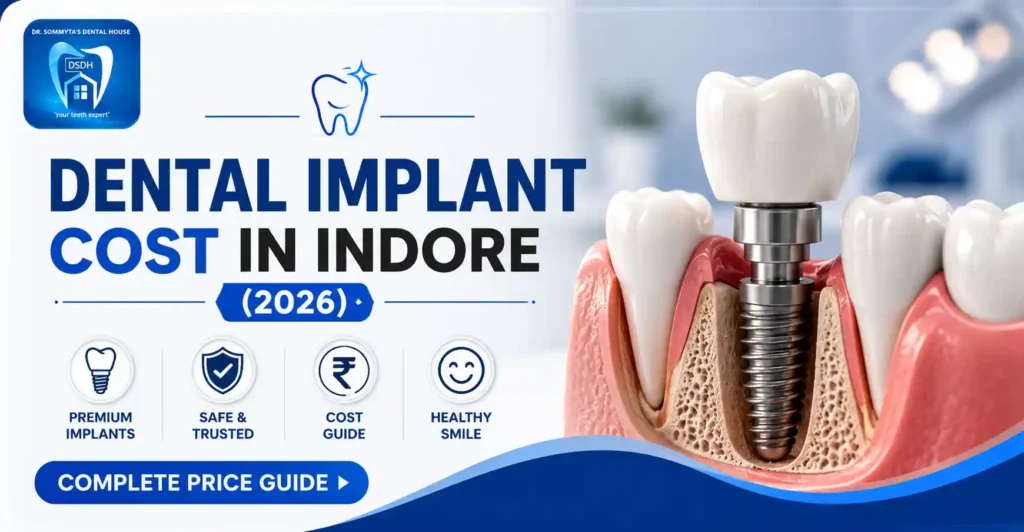
3D dental implant illustration showing a titanium implant and ceramic crown for the Dental Implant Cost in Indore (2026) complete price guide.

Dental Implant Cost in Indore (2026)

Dental implant cost in Indore generally depends on the type of implant, number of teeth being replaced, bone condition, and treatment plan. Dental implants are a long-lasting solution for missing teeth, offering better function, appearance, and durability than removable dentures or bridges. If you are searching for the dental implant cost in Indore, you are probably at the stage where you have already decided that a dental implant is the right choice for you, and now you simply want clarity on the price, the procedure, and what affects the final bill. This guide breaks down everything in simple language, so you can plan your treatment with confidence and without any confusion. At Sommyta Dental House in Ashish Nagar, Indore, we get this question almost every day from patients near Bengali Square, Vijay Nagar, and surrounding areas. So instead of giving you a vague answer, we have put together a complete, honest price guide based on real treatment patterns we see in our clinic. What is a Dental Implant? A dental implant is a small titanium screw that is surgically placed into the jawbone to act as an artificial tooth root. Once it fuses with the bone through a natural process called osseointegration, a crown is attached on top, giving you a replacement tooth that looks, feels, and functions like a natural one. Unlike a bridge, which depends on neighbouring teeth for support, or a denture, which sits removably on the gums, a dental implant stands independently. It does not touch or weaken adjacent healthy teeth, and it also helps preserve the jawbone, which naturally starts to shrink once a tooth is missing. In short, a dental implant is considered the closest thing to a natural tooth replacement available in modern dentistry. Dental Implant Cost in Indore The dental implant price in Indore usually falls within a broad range because implants are not a one-size-fits-all treatment. On average, patients can expect the following: These figures are indicative and meant to give you a realistic starting point. The exact cost of a dental implant in Indore for your specific case can only be confirmed after a clinical examination, X-ray or CBCT scan, and a discussion of your treatment goals. We always recommend an in-person or video consultation before finalising any number, because two patients with a single missing tooth can still have very different treatment plans depending on their bone quality and gum health. Also Read : Best Painless Dental Clinic Near Bengali Square, Indore Factors Affecting Dental Implant Cost Several variables influence the final dental implant cost in Indore. Understanding them helps you see why prices vary so much between clinics and between patients. 1. Number of implants needed A single tooth replacement costs far less than replacing several teeth or an entire arch. The more implants required, the higher the overall investment, though per-implant cost often reduces slightly in full mouth cases. 2. Implant brand and material Implants are available in different brands and quality tiers. Globally recognised brands with long-term clinical research tend to cost more than standard or economy options, but they usually come with better documented success rates and international warranties. 3. Bone density and additional procedures If your jawbone has resorbed due to long-term tooth loss, you may need a bone graft or sinus lift before the implant can be placed. These additional procedures add to the total treatment cost but are essential for long-term implant stability. 4. Type of crown used Crowns can be made from zirconia, porcelain-fused-to-metal, or other materials. Zirconia crowns are more aesthetic and durable but are priced higher than metal-ceramic options. 5. Diagnostic imaging A proper implant plan requires X-rays or a 3D CBCT scan to assess bone volume and nerve position accurately. This diagnostic step is a small part of the total cost but is critical for a safe procedure. 6. Dentist’s experience and clinic infrastructure An experienced implant dentist with modern equipment and a sterile, well-maintained setup may charge slightly more, but this often reduces the risk of complications and the need for corrective treatment later. 7. Location within the city Clinics in different parts of Indore, including areas like Ashish Nagar and near Bengali Square, may have slightly different pricing structures based on overheads, though the variation is usually not drastic within the city. Types of Dental Implants Not all implants are the same. Depending on your oral condition and treatment goals, your dentist may recommend one of the following: Endosteal Implants The most common type, placed directly into the jawbone. Suitable for most patients with adequate bone density. Subperiosteal Implants Placed under the gum but on or above the jawbone, generally used for patients who do not have enough healthy bone for a standard implant and prefer not to undergo bone grafting. All-on-4 and All-on-6 Implants A full arch replacement technique where four or six implants support an entire set of replacement teeth. This is a popular and cost-effective option for patients who are missing most or all of their teeth in one jaw. Mini Dental Implants Smaller in diameter, used in specific cases such as stabilising a lower denture, though they are not typically recommended as a first choice for full function replacement. Your dentist will recommend the right type only after reviewing your X-rays, medical history, and the amount of healthy bone available. Also Read : Braces Lagwane Ki Sahi Age Kya Hai Bachon Ke Liye? Single Tooth Implant Cost The single tooth implant cost is usually the starting point for most patients, especially those who have lost one tooth due to injury, decay, or a failed root canal. This cost typically includes: On average, a single tooth implant in Indore costs between ₹15,000 and ₹45,000, with premium implant systems going higher. If a bone graft is required before placement, that adds a separate cost, generally starting from a few thousand rupees depending on the amount of grafting material needed. Many patients ask why a single implant is more expensive than a bridge. While

Dental Implant Cost in Indore (2026) Read More »

Painless dental clinic near bengali square

Best Painless Dental Clinic Near Bengali Square, Indore

If you have been searching for painless dental treatment near Bengali Square Indore, you are probably someone who wants proper dental care but is not willing to go through the pain and anxiety that used to come with it. That is completely fair. Most people do not skip the dentist because they do not care about their teeth. They skip it because they remember an old, uncomfortable experience and assume every visit will feel the same way. The truth is, dentistry has moved on. With better tools, better techniques, and dentists who genuinely care about patient comfort, a pain free dentist Indore visit is no longer a rare exception. It is becoming the standard. In this guide, we will walk through what painless dentistry actually means, which treatments can be done comfortably, the technology behind it, how to pick the right dental clinic near Bengali Square, and why so many families in the area trust Sommyta Dental House for their dental needs. What Is Painless Dentistry? Painless dentistry is not a marketing slogan. It is a genuine, structured approach to dental care where the entire experience, not just the procedure itself, is designed around reducing discomfort. A comfortable dental treatment does not always mean you feel absolutely nothing. Some steps may involve mild pressure or a slight pinch. What painless dentistry really promises is that sharp, lingering pain, the kind that used to make people dread the dentist, is avoided at every stage. This is the same standard we follow at Sommyta Dental House, where every treatment plan is built around patient comfort first. Which Dental Treatments Can Be Painless? A common myth is that only simple treatments like a cleaning can be painless, while anything more serious has to hurt. That is simply not accurate anymore. With the right approach, most common dental procedures can be made comfortable. The bigger takeaway here is that pain during dental treatment today is largely optional. It depends on the tools being used and the skill of the dentist performing the procedure. Also Read : Braces Lagwane Ki Sahi Age Kya Hai Bachon Ke Liye? Technologies Used in Painless Dentistry Modern painless dentistry relies on a combination of tools that work together to reduce discomfort at every stage of treatment. This is where laser dentistry Indore clinics, digital imaging, and updated anesthesia methods come into play. Laser Dentistry Lasers are one of the biggest reasons painless dentistry works so well today. Instead of a traditional drill, many procedures can now be done using light energy. Laser dentistry Indore patients are increasingly asking for is commonly used for gum treatments, cavity treatment, minor soft tissue procedures, and even teeth whitening. Digital X-Ray Traditional X-rays meant waiting for film to develop, and sometimes retaking the image if it was not clear. Digital X-rays fix this completely. Modern Anesthesia Anesthesia has come a long way. Local anesthetics today work faster, last exactly as long as needed, and are delivered using thinner needles alongside numbing gels applied beforehand. Intraoral Cameras and Digital Scanning Small cameras let the dentist show you exactly what is happening inside your mouth on a screen. This builds transparency, and when patients understand what needs to be done and why, a lot of the anxiety around the unknown disappears. Rotary Endodontic Instruments For root canal treatments specifically, rotary instruments have replaced older hand tools. They are faster, more precise, and often reduce the number of visits needed for a painless RCT. Together, these technologies do more than remove pain. They make treatment faster, more accurate, and considerably less stressful from start to finish. Also Read : Best Dentist Near Me in Bengali Square, Indore Benefits of Painless Dental Treatment Choosing comfortable dental treatment is not just about avoiding discomfort during a single visit. The benefits extend well beyond the chair. How to Choose a Dental Clinic Near Bengali Square Bengali Square is a busy, well-connected part of Indore, and there is no shortage of dental clinics nearby. Choosing the right one takes a bit of thought. Why Patients Choose Sommyta Dental House At Sommyta Dental House, comfort is not an afterthought. It is part of how we approach every single patient who walks through our doors, and it is a big reason we are recognized as one of the best dentist near Bengali Square options for families across the area. When you put all of this together, it becomes clear why so many people searching for a dental clinic near Bengali Square choose Sommyta Dental House whenever they need treatment, big or small. Also Read : Best Sensitive Teeth Treatment Near Bengali Square, Indore (2026 Guide) Treatment Cost Table One of the most common questions patients ask is about cost. While exact pricing depends on the complexity of your specific case, here is a general idea of what to expect at Sommyta Dental House. For an accurate quote, we always recommend an in-person consultation, since every case is a little different. Treatment Approximate Cost Range Dental Checkup and Consultation Rs. 200 to Rs. 500 Digital X-Ray Rs. 200 to Rs. 600 Teeth Cleaning and Polishing Rs. 800 to Rs. 2,000 Tooth Colored Filling Rs. 1,000 to Rs. 3,000 per tooth Root Canal Treatment (RCT) Rs. 3,000 to Rs. 8,000 per tooth Crown (Ceramic or Metal) Rs. 3,000 to Rs. 10,000 per tooth Simple Tooth Extraction Rs. 500 to Rs. 1,500 Wisdom Tooth Extraction Rs. 1,500 to Rs. 5,000 Dental Implant Rs. 20,000 to Rs. 45,000 per implant Teeth Whitening Rs. 3,000 to Rs. 8,000 Braces (Metal) Rs. 20,000 to Rs. 40,000 Clear Aligners Starting from Rs. 35,000 Smile Designing or Veneers Rs. 5,000 to Rs. 15,000 per tooth Full Mouth Rehabilitation Varies, quoted after consultation These figures are meant to give you a general idea. Final costs depend on the severity of your condition, the materials used, and the number of sittings required. Book a consultation with our team for an exact estimate based on your specific needs. Sedation Dentistry for Adults

Best Painless Dental Clinic Near Bengali Square, Indore Read More »

braces lagwane ki age kya hai

Braces Lagwane Ki Sahi Age Kya Hai Bachon Ke Liye?

Agar aap ek parent hain aur aapke mann mein yeh sawal ghoom raha hai ki “mere bacche ke daant tedhe hain, ab kya karein, kab tak wait karein”, to aap akele nahi hain. Yeh sabse zyada poocha jaane wala sawal hai jo har dusra parent apne dentist se karta hai. Seedha jawab yeh hai ki bachon ko orthodontist se pehli baar milwane ki sahi age 7 saal hai, chahe unke daant dekhne mein bilkul theek hi kyun na lagein. Lekin actual braces lagwane ki age is baat par depend karti hai ki bacche ke jaw aur permanent teeth kis stage mein hain, aur yeh usually 9 se 14 saal ke beech kahin par hota hai. Is blog mein hum is poore topic ko detail mein samjhenge taaki aap confusion ke bina sahi decision le sakein. Sabse Pehle Yeh Samajhna Zaroori Hai: Checkup Aur Braces Do Alag Cheezein Hain Bahut saare parents yeh maan lete hain ki orthodontist ke paas jaana matlab seedha braces lag jayenge. Yeh sach nahi hai. American Association of Orthodontists (AAO), jo is field mein sabse authentic aur trusted organisation hai, saaf tarah se kehta hai ki har bacche ko 7 saal ki age tak ek baar orthodontic screening zaroor karwani chahiye. Iska matlab yeh nahi hai ki us age mein hi braces lag jayenge. Is age tak bacche ke kuch permanent teeth (khaas kar pehle molars aur front incisors) aa chuke hote hain, jisse orthodontist ko yeh andaza lag jaata hai ki: Yeh ek tarah ka baseline check hota hai, bilkul waise hi jaise hum bachpan mein height aur weight track karte hain. Zyada tar bachon ko is visit ke baad turant kuch nahi karna padta, sirf saal mein ek baar follow-up hota hai jab tak koi actual treatment start karne ki zaroorat na aaye. Also Read : Teeth Cleaning Near Bengali Square Indore | A Simple Guide to a Healthier, Brighter Smile Age 7 Hi Kyun? Itni Jaldi Kyun Dekhna Zaroori Hai Yeh sawal bahut logical hai. Jab tak bacche ke saare permanent teeth aa hi nahi jaate, tab tak braces ki baat karna jaldi lagta hai. Lekin science yeh kehta hai ki jitni jaldi kisi problem ko pakda jaaye, usse theek karna utna hi asaan hota hai. Iske peeche kuch clear reasons hain: Bachpan mein jaw ki growth active hoti hai, isliye agar koi skeletal problem hai jaise narrow upper jaw, to use guide karke sahi shape mein le jaana asaan hota hai. Teenage ya adult age mein jaw bones set ho chuke hote hain, isliye wahi problem fix karne ke liye surgery tak ki zaroorat pad sakti hai.  Agar jaw chhoti hai aur permanent teeth ke liye jagah kam padne wali hai, to early intervention se jaw ko dheere dheere expand kiya ja sakta hai. Isse baad mein daant nikalwane (extraction) ki zaroorat kam ho jaati hai.  Agar bacche ke front teeth zyada aage nikle hue hain, to khelte kudte waqt chot lagne ka risk zyada hota hai. Early treatment se yeh teeth safe position mein le aaye jaate hain.  Thumb sucking, tongue thrusting, ya mooh se saans lena jaisi habits agar lambe samay tak chalti rahein to yeh jaw aur bite ko affect kar sakti hain. Jitni jaldi yeh pakdi jaayein, utna behtar. Yaad rakhiye, is age mein screening ka matlab hai “abhi dekh lo taaki baad mein bada problem na bane”, na ki “abhi hi treatment shuru kar do”. Phase 1 Aur Phase 2 Treatment Ka Concept Samjhein Orthodontics mein treatment ko do phases mein baanta jaata hai, aur yeh samajhna parents ke liye bahut helpful hota hai. Phase 1: Early Interceptive Treatment (Umar 6 se 10 Saal) Yeh tab hota hai jab orthodontist ko koi specific skeletal ya growth-related problem dikhta hai jise abhi hi address karna behtar hoga. Is phase mein zyada tar simple appliances use hote hain jaise: Har bacche ko Phase 1 treatment ki zaroorat nahi hoti. Actually, zyada tar bachon ko iski zaroorat nahi padti. Yeh sirf un cases mein use hota hai jahan wait karna nuksaan de sakta hai. Phase 2: Full Braces Treatment (Umar 11 se 14 Saal) Yeh woh phase hai jise sab log “braces lagwana” kehte hain. Is age tak zyada tar permanent teeth aa chuke hote hain (usually saare 28 permanent teeth, wisdom teeth chhod kar), aur jaw ka growth bhi kaafi had tak complete ho chuka hota hai. Yeh full braces treatment ke liye sabse ideal window mana jaata hai kyunki: Agar bacche ne Phase 1 treatment nahi bhi karwaya, to bhi zyada tar bachon ke liye seedha yehi Phase 2 hi unka pehla aur akela braces treatment hota hai. Yeh bilkul normal hai. Woh Signs Jinhe Dekh Kar Aapko Turant Dentist Ke Paas Jaana Chahiye Har parent yeh nahi jaanta ki normal kya hai aur warning sign kya hai. Neeche kuch clear signs diye gaye hain jinhe agar aap apne bacche mein dekhein, to age 7 ka wait kiye bina bhi dentist se consult kar lena chahiye: Agar in mein se koi bhi sign dikhe to der mat kijiye. Jaldi checkup karwana kabhi nuksaan nahi karta, sirf peace of mind milta hai. Also Read : Best Dentist Near Me in Bengali Square, Indore | A Complete Guide (2026) Kya Har Bacche Ko Braces Ki Zaroorat Padti Hai Nahi, bilkul nahi. Yeh ek bahut common myth hai. Sach yeh hai ki har bacche ke jaw aur teeth alag tarike se develop hote hain. Kuch bachon ke daant naturally hi seedhe aur well-aligned hote hain, aisi situation mein braces ki koi zaroorat nahi hoti. Dusri taraf, kuch bachon mein genetics, thumb sucking jaisi habits, ya jaw ke size ki wajah se alignment problems ho sakti hain jinke liye orthodontic treatment helpful hota hai. Iska decision kabhi bhi sirf dekh kar nahi lena chahiye. X-rays aur clinical examination ke through hi yeh pata chalta hai ki treatment ki actual zaroorat hai ya nahi. Agar Bacche Ki Age 7 Nikal Chuki Hai To Kya Ab Der Ho Gayi Bilkul nahi. Yeh ek

Braces Lagwane Ki Sahi Age Kya Hai Bachon Ke Liye? Read More »