
Thumb sucking, mouth breathing, tongue thrusting, and teeth grinding are some of the most common oral habits in children. Most of these habits are a normal part of early childhood and fade away on their own.
The concern is not the habit itself but how long it continues, how often it happens, and how forcefully it is done. A habit a toddler outgrows by age three looks very different from the same habit continuing at age seven, once permanent teeth start coming in. This is when persistent oral habits can start to influence tooth alignment and jaw development, which is why parents are often advised to consider an early dental evaluation once a habit continues past the age it would normally stop.
Which Oral Habits Can Affect a Child’s Dental Development?
Children can develop several different oral habits, and each one affects the growing mouth in its own way. Understanding what each habit involves, and how it is different from the next, makes it easier for parents to know what is normal and what deserves a closer look from a dentist.
Thumb Sucking and Its Effects on Children’s Teeth
Thumb sucking is one of the most recognisable oral habits in early childhood, and it is completely normal in infants and toddlers. Some babies even suck their thumb before birth. It gives young children a sense of comfort and security, and many turn to it instinctively when they are tired, bored, or adjusting to something new, such as starting daycare or a new sibling arriving at home.
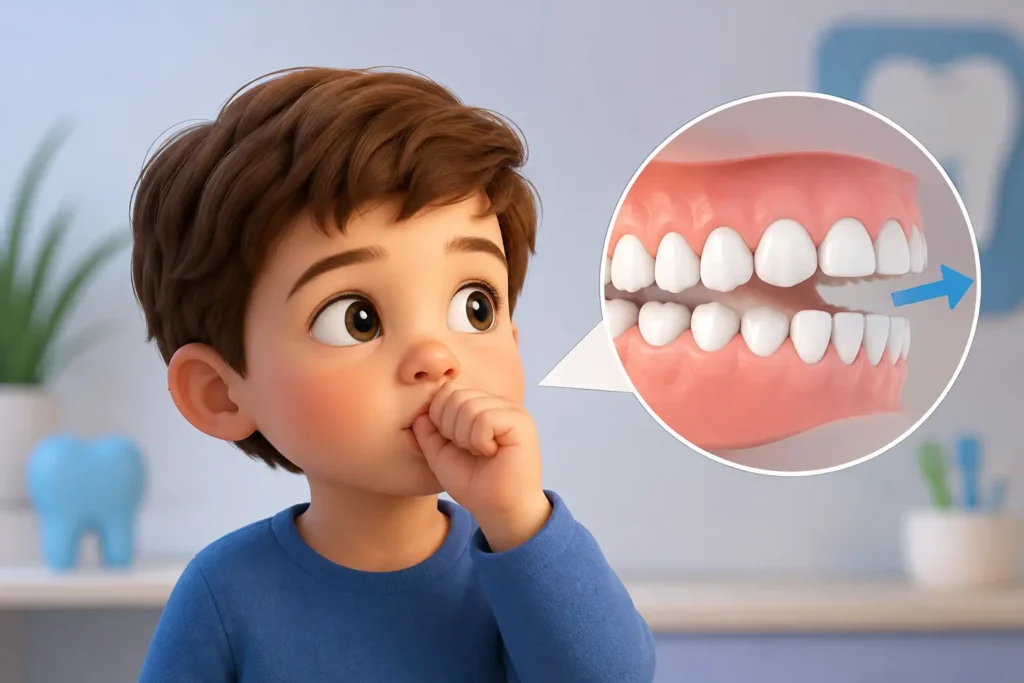
In most children, thumb sucking effects on teeth are minimal because the habit itself is short-lived. It is generally considered normal up to around age two to four, and as a child’s ability to self-soothe develops, the thumb sucking habit usually fades on its own without leaving any lasting mark on the teeth.
Problems tend to appear when the habit continues after the front permanent teeth begin to erupt, generally from around age six onward. Persistent, forceful thumb sucking places steady pressure on the front teeth and the roof of the mouth. Over time, this pressure can lead to an open bite, where the upper and lower front teeth do not meet when biting down, or to protruding front teeth and a narrower upper arch. The intensity of the sucking matters a great deal here. A child who rests the thumb passively in the mouth is far less likely to see these changes than a child who sucks vigorously and frequently.
This connection between thumb sucking and dental development has been studied extensively, and dental professionals generally agree that the duration and intensity of the habit, rather than its mere presence, determine the outcome. Parents can gently discourage the habit by praising the child during periods without thumb sucking, addressing the underlying reason for it such as anxiety or a need for comfort, and involving the child in age-appropriate ways to stop it, such as a simple reward chart. If the habit continues beyond age four, or if changes in tooth position are already visible, it is a good time to speak with a pediatric dentist.
Mouth Breathing in Children: Can It Affect Dental and Facial Development?
Mouth breathing in children happens when a child breathes primarily through the mouth instead of the nose, both while awake and during sleep. It is often easy for parents to miss at first, since it can look like a simple habit rather than a sign of something else happening in the airway.
Common signs of a child breathing through the mouth include sleeping with the mouth open, snoring, a dry mouth on waking, cracked or chapped lips, and a general preference for mouth breathing even while resting quietly during the day. Some children develop this pattern because their nasal airway is partially blocked, whether from seasonal allergies, enlarged tonsils or adenoids, or ongoing nasal congestion that has turned into a long-term habit rather than an occasional cold symptom.
Chronic mouth breathing does not only affect how a child takes in air. Because the tongue rests differently in the mouth during mouth breathing compared to normal nasal breathing, it can gradually influence how the jaw and palate grow, and prolonged mouth breathing has been linked to changes in facial development in children, including a longer, narrower facial profile in some cases. This is one of the more overlooked mouth breathing dental problems, since the effect builds up slowly and is not always obvious in the early stages.
Because of this, mouth breathing should never simply be dismissed as a bad habit that a child will grow out of. It often points to an underlying airway issue that benefits from a proper evaluation, whether from a dentist, a pediatrician, or an ENT specialist, depending on the underlying cause.
Tongue Thrusting and Its Impact on Teeth Alignment
Tongue thrusting in children refers to a swallowing pattern where the tongue pushes forward against or between the teeth, rather than pressing up against the roof of the mouth the way it should during a normal swallow. Because swallowing is an automatic action that happens dozens of times a day, even a mild tongue thrust habit repeats itself constantly.
This repetition is exactly why a persistent tongue thrust can gradually affect teeth alignment. The forward pressure on the front teeth, applied thousands of times over months and years, can contribute to an open bite or noticeable spacing between the upper front teeth. Tongue thrusting effects on teeth are often similar to those seen with prolonged thumb sucking, since both involve sustained pressure on the same group of teeth.
Abnormal tongue movement in children is also sometimes associated with speech concerns, particularly with sounds like “s” and “z,” since the position of the tongue plays a direct role in how these sounds are formed. Tongue thrusting frequently overlaps with other oral habits, such as prolonged thumb sucking or mouth breathing, so a dentist evaluating one habit will usually check for the others as well. Early evaluation allows the habit to be addressed through simple guidance or, where appropriate, myofunctional therapy, before it has a lasting effect on how the teeth come together.
Teeth Grinding at Night: Why Does My Child Grind Their Teeth?
Teeth grinding in children, medically known as bruxism, is fairly common and usually happens during sleep, which means parents often become aware of it only after hearing the grinding sound from another room or noticing signs of it the following morning.
The exact reason a child grinds their teeth at night is not always clear, and it is rarely caused by just one thing. Night teeth grinding in kids has been associated with factors such as stress or excitement, an uneven bite between the upper and lower teeth, teething discomfort in younger children, and general sleep patterns. In many cases, bruxism in children resolves naturally as the permanent teeth come in and the bite settles into its adult position.
Signs of child teeth grinding that parents may notice include a grinding or clicking sound during sleep, complaints of jaw soreness or headache in the morning, and visible wear or flattening on the biting surfaces of the teeth. Occasional, mild grinding usually does not need active treatment, but frequent grinding accompanied by tooth wear, sensitivity, or ongoing jaw discomfort is worth discussing with a dentist, who can check whether the habit is affecting the teeth and rule out any underlying cause that needs separate attention.
Other Common Oral Habits Parents Should Watch For
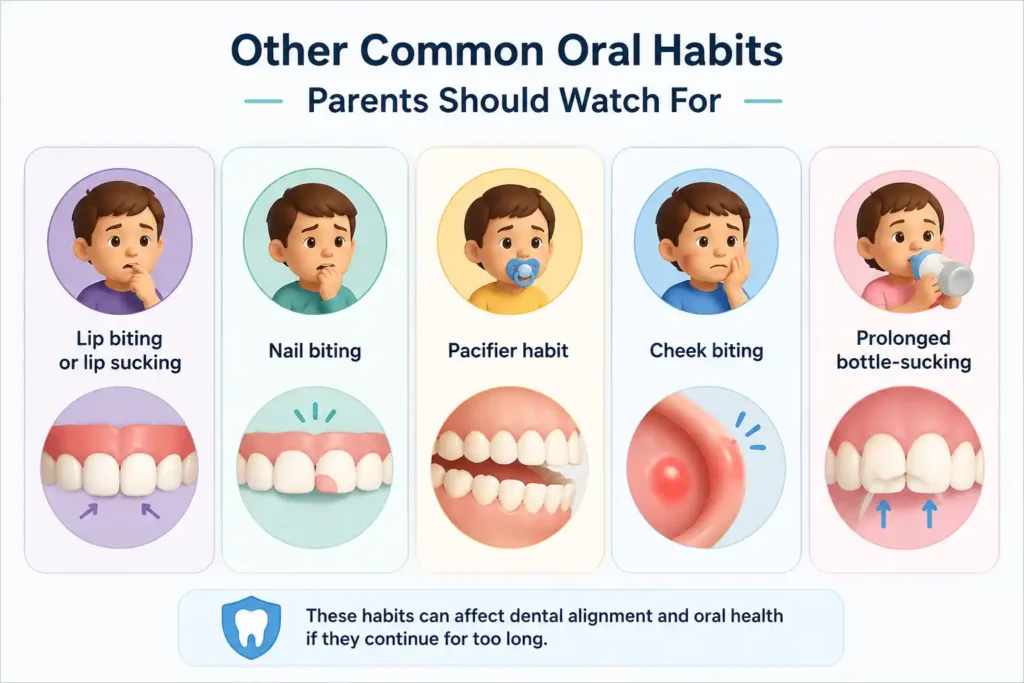
Beyond the habits above, a few other behaviours fall into the same broader category of common oral habits in children and are worth keeping an eye on:
- Lip biting or lip sucking, which can place pressure on the front teeth similar to thumb sucking, particularly when it becomes a frequent, unconscious habit.
- Nail biting, a habit that can affect the edges of the front teeth over time and is often linked to stress, boredom, or anxiety.
- Pacifier habit, which has effects on the teeth comparable to thumb sucking, though it is usually somewhat easier for parents to phase out gradually.
- Cheek biting, which can lead to irritation or soreness of the inner cheek tissue if it happens repeatedly.
- Prolonged bottle-sucking habits, extending well beyond the toddler years, which can affect both tooth alignment and the risk of early childhood cavities, especially when a bottle is used at bedtime.
Any of these harmful oral habits, when persistent, deserve the same attentive approach as thumb sucking, mouth breathing, or teeth grinding: watch for how long they continue, and involve a dentist if they carry on past the age they would typically stop.
How Can Oral Habits Affect a Child’s Teeth and Bite?
Persistent childhood oral habits can influence the teeth, the bite, and the overall growth of the jaw and face, though the exact outcome depends on factors such as how long the habit continues, how often it happens, how forceful it is, and the child’s own individual pattern of growth. Not every child with one of these habits develops dental changes, but understanding the range of possibilities helps parents know what to look for and when to seek guidance.
Changes in Teeth Alignment
Repeated pressure from habits like thumb sucking, tongue thrusting, or lip sucking can gradually shift how the teeth sit in the mouth. This may appear as crooked teeth, front teeth that protrude outward, unusual spacing between teeth, or teeth that are simply positioned differently than expected for the child’s age and stage of dental development.
Changes in Bite and Jaw Development
The bite refers to how the upper and lower teeth meet when the mouth closes. Prolonged oral habits can contribute to an open bite, where the front teeth do not touch even when the back teeth are closed together, a crossbite, where the upper and lower teeth do not align correctly from side to side, or an increased overjet, where the upper front teeth extend noticeably beyond the lower ones. In some children, these early changes can be a sign of a developing malocclusion that benefits from monitoring.
Possible Effects on Facial Growth and Oral Function
Because the mouth, jaw, and face develop together during childhood, habits that affect tongue position, breathing pattern, or swallowing can also have a broader influence on jaw development and facial growth over several years. Some children also experience related speech difficulties, since the position of the tongue and teeth plays a direct role in how certain sounds are formed and articulated.
What Signs Should Parents Look for in Their Child?
Parents are usually the first to notice when something about their child’s oral habits or dental development looks different from before. The signs below are meant to help you know what to watch for at home, not to suggest a diagnosis, which only a dental professional can provide after an examination.
Signs of Thumb or Finger Sucking
A visibly reddened or callused thumb, a habit that continues well past age four, or noticeable changes in how the front teeth are positioned compared to before.
Signs of Mouth Breathing
Sleeping with the mouth open, frequent snoring, waking up with a dry mouth, or breathing through the mouth even while sitting quietly during the day.
Signs of Tongue Thrusting
The tongue visibly pushing against or between the front teeth while swallowing, along with speech sounds that seem slightly unclear or lisped.
Signs of Nighttime Teeth Grinding
A grinding sound heard during sleep, complaints of jaw soreness in the morning, or visible flattening on the biting edges of the front or back teeth.
When Changes in Teeth or Bite Need Attention
Front teeth that appear to be shifting position, a bite that looks uneven when the child closes their mouth, gaps that seem to be widening, or difficulty biting and chewing comfortably.
If you notice any of these signs, the right next step is not to worry on your own but to have your child’s dental development looked at by a professional who can assess the situation properly and explain what, if anything, needs to be done.
When Should You Take Your Child to a Pediatric Dentist?
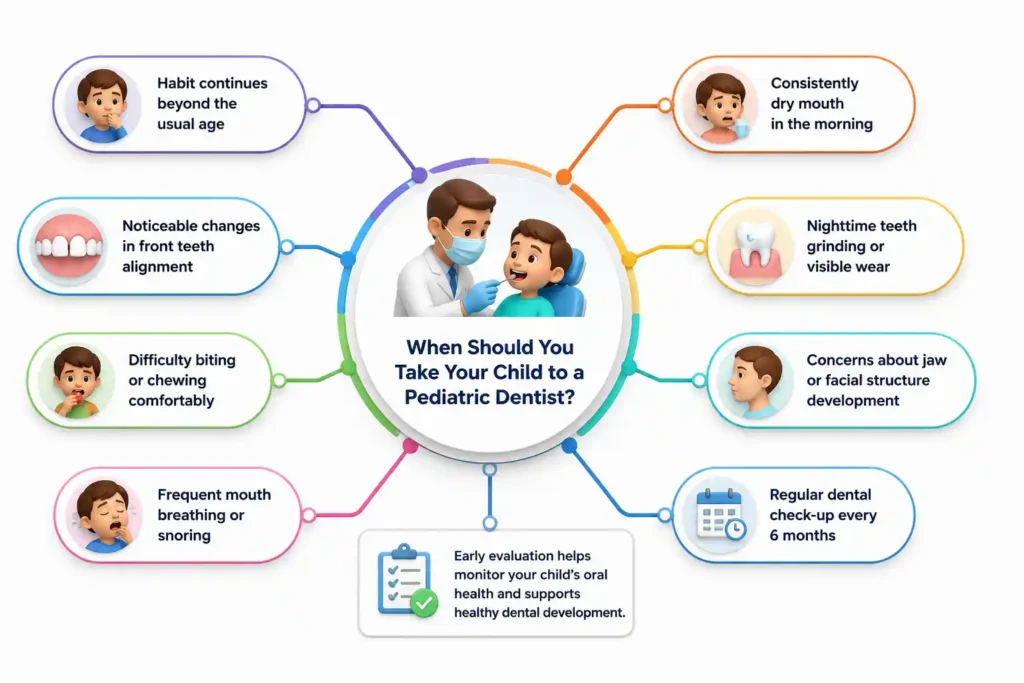
There are a few situations where scheduling a dental evaluation makes more sense than simply waiting to see if a habit resolves on its own:
- An oral habit, such as thumb sucking or mouth breathing, that continues well beyond the age it would typically stop.
- Noticeable changes in how the front teeth are aligned or positioned.
- Difficulty biting or chewing comfortably, or avoiding certain foods because of discomfort.
- Frequent mouth breathing, particularly if it comes with snoring or a consistently dry mouth in the morning.
- Nighttime teeth grinding that happens often or is accompanied by visible tooth wear.
- Any concern about how the jaw or facial structure is developing compared to what feels typical for the child’s age.
- The general recommendation of a preventive dental check-up every six months, which allows a dentist to track dental development over time rather than only stepping in once a problem has already become visible.
An early evaluation does not automatically mean treatment is needed. In many cases, it simply means monitoring the habit and the child’s developing teeth at regular intervals, so that any changes are identified and guided as early as possible. The Indian Dental Association highlights early dental assessment as a key part of guiding a child’s oral development, since it allows dental professionals to identify concerns such as non-nutritive sucking habits and address them before they become more significant. For further reading on the causes and management of digit-sucking habits in children, the National Health Portal of India, an initiative of the Ministry of Health and Family Welfare, Government of India, also outlines the clinical background parents may find useful.
How Are Harmful Oral Habits Managed in Children?
Managing an oral habit in a child is rarely a one-size-fits-all process. The right approach depends on the specific habit, how long it has continued, the child’s age, and how it is affecting their teeth and bite so far.
Identifying the Cause of the Habit
The first step is usually understanding why the habit exists in the first place. Habits like thumb sucking or nail biting are frequently tied to a need for comfort or a response to stress or a change in routine, so addressing the root cause is often more effective in the long run than focusing on the visible behaviour alone.
Positive Habit-Modification Techniques
Simple, encouraging approaches tend to work best with young children. This can include praising the child for periods without the habit, gently reminding them when it happens rather than scolding, and offering an alternative way to feel calm or occupied, such as a favourite toy, a book, or a short activity at the times the habit tends to show up.
Myofunctional or Other Professional Approaches
For habits like tongue thrusting or persistent mouth breathing, a dentist may recommend exercises or therapy focused on retraining how the tongue, lips, and jaw muscles function together. This approach works on correcting the underlying movement pattern rather than only addressing the visible symptom.
Orthodontic or Habit-Breaking Appliances When Required
In some cases, particularly when a habit has continued long enough to noticeably affect tooth position, a dentist may suggest a habit-breaking appliance. These are used selectively, based on the child’s specific situation and the dentist’s assessment, rather than as a routine first step for every child.
Importance of Early Evaluation
Not every child with an oral habit will need active treatment. Management depends entirely on the individual habit and the child’s own pattern of dental development, which is exactly why an early evaluation matters. It gives a dentist the information needed to decide whether simple monitoring is enough, or whether further guidance and follow-up are appropriate.
How Sommyta Dental House Supports Children’s Dental Health in Indore
Sommyta Dental House is a dental clinic in Indore that combines advanced dental techniques with gentle, patient-first care, backed by more than 10 years of experience. Watching for oral habits and their effect on a child’s growing smile is easier with the guidance of a dental team that understands paediatric dental development closely, and this is the approach followed at the clinic.
Child-Friendly Dental Evaluation
Every visit is designed to be calm and reassuring for children, so that check-ups feel like a routine, comfortable part of growing up rather than something to be anxious about.
Monitoring Teeth, Bite and Dental Development
Regular evaluations help track how a child’s teeth, bite, and jaw are developing over time, making it far easier to notice small changes early rather than after they have become more established and harder to guide.
Guidance for Parents on Oral Habits
Parents are given practical, realistic guidance on habits like thumb sucking, mouth breathing, tongue thrusting, or teeth grinding, including when a habit is likely to resolve on its own and when it is worth monitoring more closely.
Preventive Kids Dental Care in Indore
Preventive care remains the foundation of good paediatric dental health. The Kids Dental Care in Indore services at Sommyta Dental House are built around this approach, combining regular check-ups with early habit guidance so that small concerns are addressed well before they affect a child’s developing smile. Families exploring the full scope of treatments offered for children and adults can also browse the complete list of dental services in Indore provided at the clinic.
Parents in and around Ashish Nagar, Bengali Square, and Tilak Nagar in Indore who notice persistent thumb sucking, mouth breathing, tongue thrusting, teeth grinding, or any change in their child’s bite can consider a professional dental evaluation at Sommyta Dental House. Being centrally located near Bengali Square and Tilak Nagar also makes it a convenient choice for families in these neighbourhoods who are searching for a kids dentist in Indore or a pediatric dentist in Indore closer to home.
Sommyta Dental House Address: 29A, Ashish Nagar Rd, Ashish Nagar, Indore, Madhya Pradesh 452016 Phone: +91 94258 16183 Email: info@sommytadentalhouse.com
To book a consultation for your child, call the clinic directly or visit the Contact Us page for appointment details and clinic timings.
Related Reading
If you found this guide useful, these articles cover related dental concerns for families in and around Bengali Square, Indore:
- Trusted Kids Dentist in Bengali Square — a closer look at what to expect from a child-friendly dental clinic near Bengali Square.
- Tooth Pain Treatment Near Bengali Square, Indore — a complete guide to identifying and treating tooth pain, useful for parents dealing with a child’s dental discomfort.
- Best Sensitive Teeth Treatment Near Bengali Square, Indore — helpful if grinding or enamel wear has left your child’s teeth feeling sensitive.
- Teeth Cleaning Near Bengali Square Indore — a simple guide to routine cleaning, an essential part of preventive care alongside habit monitoring.
Frequently Asked Questions About Oral Habits in Children
Is thumb sucking bad for a child’s teeth?
Not necessarily. Thumb sucking is a normal habit in infants and young toddlers and usually resolves on its own by age two to four. It becomes a concern mainly when it continues forcefully well past this age, particularly once the permanent front teeth begin to erupt.
Can mouth breathing affect a child’s teeth?
Yes. Chronic mouth breathing can influence how the jaw and palate develop over time and is often linked to an underlying airway issue, so persistent mouth breathing in a child is worth having evaluated rather than left unaddressed.
What is tongue thrusting in children?
Tongue thrusting is a swallowing pattern where the tongue pushes against or between the front teeth instead of pressing against the roof of the mouth. Since swallowing happens many times a day, a persistent tongue thrust can gradually affect tooth alignment.
Why does my child grind their teeth at night?
Nighttime teeth grinding, or bruxism, in children can be related to factors such as an uneven bite, teething, or general sleep patterns. It is common and often improves on its own, though frequent grinding with visible tooth wear should be checked by a dentist.
When should I worry about my child’s oral habits?
An oral habit is generally worth discussing with a dentist if it continues well past the age it would typically stop, if it happens forcefully or frequently, or if you notice changes in your child’s teeth, bite, breathing, or speech.
Can oral habits change a child’s bite?
They can, depending on the habit’s duration, frequency, and intensity. Persistent habits such as thumb sucking or tongue thrusting have been associated with bite changes like an open bite, crossbite, or increased overjet in some children.
When should a child visit a pediatric dentist?
Beyond routine six-monthly check-ups, it is a good idea to schedule a visit if an oral habit continues beyond its typical age, if you notice changes in tooth alignment or bite, or if there are ongoing concerns about breathing, chewing, or jaw development.